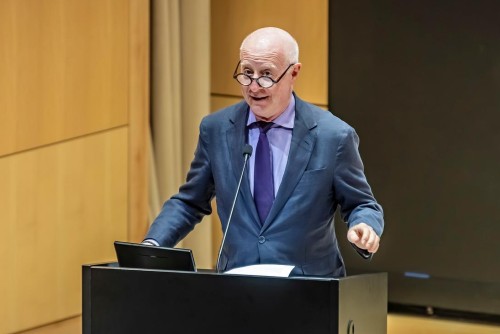
On April 24, 2026, the Kenyon community gathered to celebrate the life of visionary architect Graham Gund ’63 H’81. The following remarks were given by Pulitzer Prize-winning architect Paul Goldberger H’05 P’04.
I first saw Kenyon in 1999, when my son Ben, who is a member of the Class of 2004, was looking at colleges. We had visited a lot of colleges that year, but none of them had the qualities of Kenyon — not just physical beauty, but a kind of exquisite urbanity, you might call it, something magical about Middle Path and the way in which it served as a spine for the entire campus, and how it started at Old Kenyon and then made its way right through the center of the village and then to the north end of the campus to culminate at Bexley Hall. There was both a grand vision and modesty, in harmony with each other — and Middle Path also makes for the most subtle and natural integration of a campus and town that I have ever seen.
I thought it was the most beautiful small campus I’d seen, even though there were a few things that were not quite right — the famous Kenyon Bookstore was housed in something that looked like a suburban strip mall, and the athletic facilities were sub-par, and the housing wasn’t so great, and the library looked like it had been designed by an architect who had never been to the campus when he designed it. Before long I learned that I was not alone in having these perceptions of the campus — there was someone else whose thoughts about Kenyon were similar, and that this person, unlike me, was in a position to do something about it, and had already begun to do so.
The person, of course, is Graham, whose extraordinary relationship to Kenyon is like no other architect’s relationship to any campus, and like few other philanthropists’ relationship to any institution. The word that comes first to mind is “transformed,” but to say that Graham transformed Kenyon is both too grand and too unsubtle, because what Graham did here was something much more profound than transformation. Graham did not want to make Kenyon different. He understood the beauty inherent in this place, and he worked to strengthen it, building by building, not to change Kenyon but to make it more what it had always wanted to be. And he understood the beauty of the way in which the village and the campus connected to each other, almost like fingers intertwined, and he made that relationship even stronger and even better.
We are fortunate to have had in Graham an architect who instinctively wanted to protect this campus and also to make it bigger and better, and who was determined to show that there did not have to be a contradiction between these two things. That, as much as any specific building, is his true achievement here. Graham’s work at Kenyon reminds me of that great line from the Italian novel “The Leopard” — a literary reference, of course, is never out of place at Kenyon — that line in which it is said that “If we want things to remain the same, then they will have to change.”
Graham has kept Kenyon the same, by changing it — and changing it with knowledge, sensitivity, and good architecture. A quarter century after I first saw this campus (and how amazing to think that this constitutes one-eighth of the college’s 200-year history), Kenyon’s campus is now, thanks to Graham, better than it has ever been.
The bookstore is now in a different building that enhances rather than weakens the tiny village; the Lowry Athletic Center is not only an extraordinary facility but a magnificent and exhilarating work of architecture; we have more and better housing, although still not enough; we have the health center as a further anchor in the village; and as for the library, well, the new Chalmers Library is not only a thousand times better than its predecessor as a work of architecture, it is also a comfortable and happy part of the larger campus.
These buildings, and many more on campus, including the rest of the West Quad, the Science Quad, Eaton Center, The Gund gallery, and others, all follow the College’s master plan, which Graham crafted to guide growth, based on a deep understanding of the qualities of the original campus, and provides a blueprint for expanding and continuing to build in a way that strengthens, rather than ignores or undermines, our original campus layout and its relation to the village. So it is not a transformation so much as a realization, a way of building and growing that has helped the college, as a physical place, become what it has always sought to be.
We all know that Graham played two roles at Kenyon: his public one as an architect, and his private one as a donor. It is not easy to wear these two hats at the same time, and Graham balanced these two roles with grace and sensitivity. He knew that the college was his client and had to be listened to, even if he was also, behind the scenes, the donor making a certain project possible. His natural manner made this easier: the adjectives that so often came up when people talked about Graham were words like “quiet,” “understated,” “gentle,” “soft-spoken,” and so forth.
It’s all true, of course, and so many of us have had the experience of talking with Graham when he has let silence say volumes. Not the least of his memorable qualities was how refreshing it was to realize, every time you were speaking with him, that this was someone of great accomplishment, great cultivation, great means, and great influence, who was also a person of great restraint. In an age of wildly inflated egos, Graham not only knew how to listen, he also took great pleasure in listening, and he taught all of us, I think, to understand the virtues of careful, thoughtful, measured discourse. Indeed, I think that the one career Graham never, ever could have succeeded at would have been as a cable tv host because he could never have met the most important qualification for that job, which is to want to shout over everyone else.
But woe to anyone who mistook Graham’s quiet for tentativeness, for a lack of conviction, or for meekness. Graham was not meek. He was one of the most determined people I have ever met. He could be stubborn, and he was quick to let you know when he thought something wasn’t right. At Kenyon, if something concerned him, he would speak only from the vantage point of the architect, not the donor. “Do you really think this detail is right,” he would say, quietly, but in a way that was not nearly as hesitant as his tone would suggest. Or “I don’t think it is a very good idea to substitute tile for slate here, do you?” or “Doesn’t Dave [or John, or whoever was the college official in charge of overseeing construction] understand that if you choose this cheaper material now, it will fall apart sooner and cost you more in the long run?”
That was the essence of Graham. He always thought in terms of the long run, not the short run. His architecture, his philanthropy, his art collecting, and his friendships were all for the long term. He did not deal in transient things, although he had the ability to take great joy in living in the moment. But what he cared about most of all were the things that would last — art, architecture, his love for Ann and his family, and Kenyon. And nothing will last longer, for all of us, than the love and respect we will feel for Graham for the rest of our days.