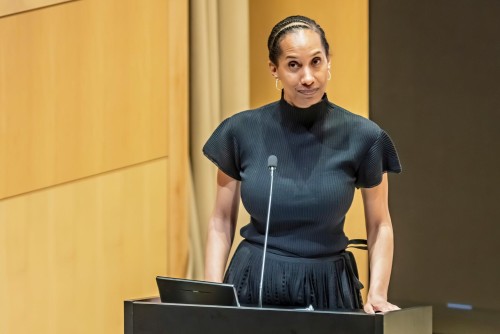
On April 24, 2026, the Kenyon community gathered to celebrate the life of visionary architect Graham Gund ’63 H’81. The following remarks were given by Daisy Desrosiers, the David and Francie Horvitz Family Foundation Director and Chief Curator of The Gund.
To know Graham Gund was to understand that his relationship to art was never abstract. It was lived — through attention, curiosity, and a quiet but unwavering belief that art belongs within the fabric of everyday life. Not as ornament, but as a way of thinking, of seeing, of being.
At Kenyon, that belief found form within a larger vision: that the spaces we build shape how we move, how we think, how we come together. The Gund, our beloved museum, is inseparable from that understanding. It carries forward his conviction that art matters here — that it has the capacity to shape a community, and, in turn, to ask something of us.
From the beginning, his vision was expansive yet precise. He imagined a place where art would not stand apart from the academic mission, but would animate it — where students, faculty, artists, and visitors might encounter works that challenge, unsettle, and sustain thought over time. A place where art is not simply encountered once, but returned to — lived with — allowed to unfold.
What distinguished Graham was not only what he made possible, but how he remained within it. He asked questions. He engaged — with students, with artists, with ideas — with a genuine appetite for what might be learned, and how that learning might continue to evolve him. He paid attention. And in that attention, he made clear that this was never a symbolic gesture. It was a living commitment.
What defined him was a quiet insistence on living with art — not occasionally, but as a necessity. He did not separate it from the world; for him, art was already entangled with history, politics, ethics, and lived experience. He approached each artwork not to resolve it, but to remain with it — allowing its complexity to unfold over time.
During my first days at Kenyon, “Pivot” by Richard Serra was being installed. It was an exacting, deeply physical process — demanding precision, patience, and a kind of collective endurance. For the art historian in me, it felt nothing short of extraordinary; for the newly appointed first-time director, it was, quite honestly, terrifying.
And yet, what I encountered in that moment was a profound generosity of expertise — and I thought about what this gift would represent for Kenyon, I felt I could understand Graham a bit more. That his love for this institution was boundless and that he would commit only to the best, like Serra, at the service of this institution.
At the end of that very long first day of installation, Graham called. When he asked, “So, how was today? Anything special happening?” there was a lightness — an understated humor — that I can still hear. I, meanwhile, was still standing in what felt like a chaotic, yet undeniably impressive, construction site — 3 cranes, 75 technicians around. That small exchange held something essential about him: a sensibility at once precise and gentle, observant without ever imposing.
Pivot resists immediacy. It asks for time. It asks for a kind of looking that does not rush, but instead lingers. Meaning does not announce itself; it gathers — through duration, presence, and a willingness to remain with complexity.
Over time, I have come to understand Graham in much the same way. Through the steadiness of his belief, the depth of his commitment, and his quiet conviction that meaning — and impact — emerge through sustained engagement.
What meant the most to me was the opportunity to come to know the person behind the name — to consider him a mentor, and, over time, a friend. Through him, I came to understand that philanthropy is not only about giving, but about presence. That generosity is not only material, but intellectual and emotional. That to build an institution is, at its core, to shape the conditions for others to think, to feel, and to gather.
He showed up — again and again. For exhibitions, for conversations, for ideas he embraced and those he questioned. He listened with care, engaged with rigor, and remained open to perspectives beyond his own. His curiosity was active, sustained, and deeply generous. If he encountered something compelling, he shared it. If challenged, he stayed with it and asked more questions.
During our first meeting in Cambridge (Mass.), he picked me up at the airport, and what followed were twelve uninterrupted hours of looking at art. Not rushed, not dutiful, but attentive in the fullest sense. We moved from one work to another, from one museum to another and, in the end, I was introduced to his incredible collection guided by both curiosity, anecdotes, and deep looking. To be with Graham in those moments was to understand that looking, for him, was never passive. It was a form of care. A form of commitment. A form of being and learning together.
Graham led in this same way. Quietly, but with precision. He held high expectations — not through insistence, but through an appetite for what might be possible. His leadership was grounded in conviction rather than recognition. To work alongside him was to be called into a deeper level of attention, and responsibility.
I could not have anticipated the extent to which he would shape me. His influence reaches into how I lead, how I look at art, and how I think with it. He taught me that ambition doesn’t mean acting in a state of urgency but on the contrary, staying with the idea as you slowly execute with attention. That returning — to a work, to a question — is not repetition, but practice. That meaning is not immediate, but built over time, through patience and consistency. And to this day I can say without hesitation that he remains one of the most extraordinary people I have had the privilege of looking at art with — and by far, one of my favorites.
Through him, I came to understand the museum not simply as a site of presentation, but as a space of continuous learning — where growth is measured by our capacity to remain open, to deepen our inquiries, and to stay with what is not yet resolved.
To look, as he modeled, is also to look forward: to allow each encounter with art to inform how we imagine what comes next.
Our museum — now newly accredited — carries this forward. Not as a conclusion, but as something still unfolding, shaped by the people, the artworks, and the questions that move through it.
For that — and for Graham, and for Ann, whose partnership in this vision has been so essential — we are deeply, and enduringly, grateful.
You are, and you will be missed, dear Graham, but certainly, never forgotten.