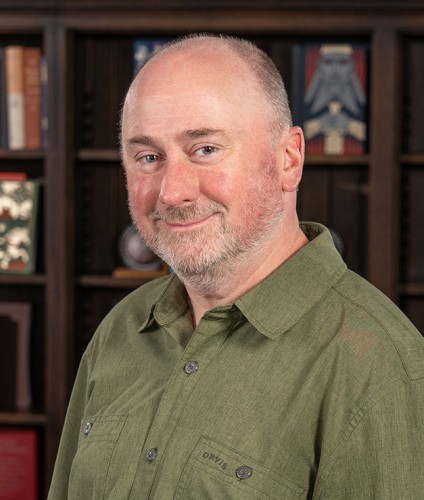
Prior to his 2002 arrival at Kenyon, Bob Milnikel studied at Carleton College and Cornell University and taught at Wellesley College. His research is focused on the mathematical analysis of logic as used in computer science. His teaching includes introductory-level courses across mathematics, CS and statistics, as well as intermediate and advanced courses in logic and proof and occasional team-teaching the Philosophy Department. He has been active in the Kenyon Educational Enrichment Program (KEEP) since 2016.
Milnikel is also active in several Kenyon and community musical ensembles, including the Kenyon Symphonic Wind Ensemble and the Knox Community Jazz Orchestra.
1999 — Doctor of Philosophy from Cornell University
1996 — Master of Science from Cornell University
1992 — Bachelor of Arts from Carleton College, Phi Beta Kappa
Courses Recently Taught
This course presents an introduction to computer programming intended both for those who plan to take further courses in which a strong background in computation is desirable and for those who are interested in learning basic programming principles. The course will expose the student to a variety of applications where an algorithmic approach is natural and will include both numerical and non-numerical computation. The principles of program structure and style will be emphasized. May be paired with COMP 218 or with any mathematics or statistics course to satisfy the natural science diversification requirement. No prerequisite. Offered every semester.
In this course, students will gain experience analyzing, interpreting, and critiquing quantitative claims and communicating results and conclusions using graphical representations of data. Examples will be drawn from across the natural and social sciences, with context provided for each data set, so that students from any disciplinary background can participate in and benefit from this course. This course has no pre-requisites. It will be taught at a level accessible to all Kenyon students. Excellent preparation for further work on quantitative topics, this course will hone students' ability to apply mathematical techniques including graphing, statistics, linear and non-linear regression, and modeling the graphical behavior of mathematical functions to understanding and interpreting data. Students will practice these skills by engaging in critical reading of primary sources, oral presentation of quantitative data, and expression of analytic ideas in writing. Assessment will be based on in-class assignments, monthly quizzes, and oral reports on data-driven projects selected in consultation with the instructor.
Our intuitions about sets, numbers, shapes and logic all break down in the realm of the infinite. Seemingly paradoxical facts about infinity are the subject of this course. We discuss what infinity is, how it has been viewed through history, why some infinities are bigger than others and how a finite shape can have an infinite perimeter. This very likely is quite different from any mathematics course you have ever taken. This course focuses on ideas and reasoning rather than algebraic manipulation, though some algebraic work will be required to clarify big ideas. The class is a mixture of lecture and discussion, based on selected readings. Students can expect essay tests, frequent homework and writing assignments. This course does not count toward any major requirement. Students who have credit for MATH 222 may not receive credit for this course. No prerequisite. Offered occasionally.
The first course in the calculus sequence, this course covers the basic ideas of differential calculus. Differential calculus is concerned primarily with the fundamental problem of determining instantaneous rates of change. In this course, we study instantaneous rates of change from both a qualitative geometric and a quantitative analytic perspective. We cover in detail the underlying theory, techniques and applications of the derivative. Elementary differential equations and their applications are also introduced, along with the basics of anti-differentiation. Students who have 4 semester hours of credit for calculus may not receive credit for MATH 111. This counts toward the core course requirement for the major. Prerequisite: solid grounding in algebra, trigonometry and elementary functions. Offered every semester.
This course introduces students to mathematical reasoning and rigor in the context of set-theoretic questions. The course covers basic logic and set theory, relations — including orderings, functions and equivalence relations — and the fundamental aspects of cardinality. The course emphasizes helping students read, write and understand mathematical reasoning. Students are actively engaged in creative work in mathematics. Students interested in majoring in mathematics should take this course no later than the spring semester of their sophomore year. Advanced first-year students interested in mathematics are encouraged to consider taking this course in their first year. This counts toward the core course requirement for the major. This course cannot be taken pass/D/fail. Prerequisite: MATH 213. Offered every semester.
This course is a mathematical examination of the formal language most common in mathematics: predicate calculus. We examine various definitions of meaning and proof for this language and consider its strengths and inadequacies. We develop some elementary computability theory en route to rigorous proofs of Godel's Incompleteness Theorems. Concepts from modal logic, model theory and other advanced topics are discussed as time permits. This counts toward the algebraic (column A) elective for the major. Prerequisite: MATH 222. Offered occasionally.
The language and basic structures of sets are used throughout mathematics, but the set theory used there is often characterized as "naive." A rigorous axiomatic treatment which avoids paradoxes around infinite sets takes care and thought, especially with regard to infinite cardinalities. We start from the fundamental axioms, move to a careful treatment of the natural numbers as sets, and then to the heart of set theory: Infinite ordinal and cardinal numbers. This counts toward the algebraic (column A) elective for the major. Prerequisite: MATH 222. May be offered every other year.
This is a team-taught course on philosophical issues in mathematics. We ask questions like "What is a number?", "What constitutes a mathematical proof?" and "How can we be certain of mathematical knowledge?" We look at the question of how something as abstract as mathematics can have any use or connection to reality. This course counts toward the epistemology requirement for the major. Permission of instructor is required. Contact either Professor Milnikel or Professor Richeimer. Prerequisite: PHIL 201 or some coursework in mathematics.
Aristotle developed a formal logic approximately 400 BC. Few thought that there could be improvements in Aristotelian logic. Logic was considered complete. Yet at the end of the 19th century, a new logical system was developed which was seen by most as an improvement over traditional logic. Again, many people can’t imagine that there could be controversies within logic or that logic could be improved. But, in fact, there are deep disputes. For instance, some thinkers believe that modern logic includes what they take to be invalid inferences (one such group is called the “intuitionists”). And they have developed an alternative logic and mathematics. Other groups of thinkers are outraged because modern logic excludes what they take to be perfectly valid arguments. And they have developed seemingly alternative logics. And so --it seems that there is more than one logic. One issue we examine is -- are there really alternative logics? And if so, how do you decide which logic is correct? Another such issue is the occasional conflict between the logic we use every day and the formal logic that we teach. At times, they seem to conflict. Which should be dominant – informal reasoning or formal logic? In addition, from seemingly unexceptionable reasoning and from unexceptionable premises one can at times derive contradictions (the so-called “paradoxes”). What does that tell us about logic? We examine these issues and others in this team-taught course. Prerequisite: PHIL 201. Offered every three years.\n
This course presents an introduction to computer programming intended both for those who plan to take further courses in which a strong background in computation is desirable and for those who are interested in learning basic programming principles. The course will expose the student to a variety of applications where an algorithmic approach is natural and will include both numerical and non-numerical computation. The principles of program structure and style will be emphasized. SCMP 118 may be paired with SCMP 218 or either may be paired with any mathematics or statistics course to satisfy the natural science diversification requirement. No prerequisite. Offered every semester.
This is a basic course in statistics. The topics covered are the nature of statistical reasoning, graphical and descriptive statistical methods, design of experiments, sampling methods, probability, probability distributions, sampling distributions, estimation and statistical inference. Confidence intervals and hypothesis tests for means and proportions are studied in the one- and two-sample settings. The course concludes with inference-regarding correlation, linear regression, chi-square tests for two-way tables and one-way ANOVA. Statistical software is used throughout the course, and students engage in a wide variety of hands-on projects. This counts toward the core course requirement for the major. Students with credit for STAT 116 cannot take STAT 106 for credit. No prerequisite. Offered every semester.