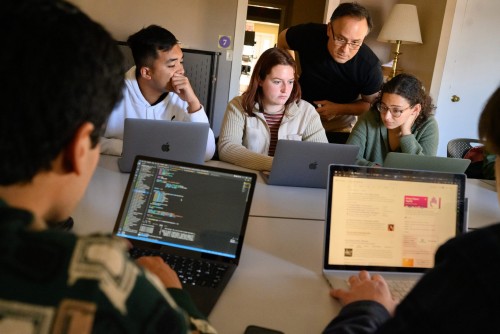
Some questions are older than the majors you now choose. What does it mean to be human? What is a flourishing life? What makes a society good, and who should hold power in it? Long before universities siloed knowledge into departments, these questions formed a single conversation. Humane studies is the field that keeps that conversation whole.
Kenyon has housed that conversation since 1975. The Integrated Program in Humane Studies is the College's oldest interdisciplinary program, and its year-long Odyssey sequence still works the way few courses anywhere do: students read from Homer and Plato through Dante, Shakespeare, Darwin and Marx, with lectures from faculty across the College, a seminar of fifteen, and tutorials where each student defends a short paper in person. The program teaches students to find the questions that need to be asked, not just to answer the ones others are already asking.
Those questions carry new weight now that we live among machines that write, argue, and decide. In 2016, IPHS faculty Kate Elkins and Jon Chun created the world’s first human-centered AI curriculum and founded the AI CoLab, built on a conviction the program had held for forty years: the questions come before the code.
Today the program pursues the same questions with whatever methods they require. Students asking about power trace political discourse across 316,000 tweets and surveillance capitalism through social media terms of service. Students asking what we can know study 17,000 real human-chatbot exchanges to understand what kinds of relationships we are forming with our AI systems. Students asking what creativity is fine-tune language models on Donne and judge whether the results are poetry. This is humane studies in its current form, and students graduate with portfolios of original research downloaded more than 100,000 times by readers at more than 4,000 institutions in 198 countries.
The work is recognized well beyond Gambier. Schmidt Sciences funds faculty trying to rescue disappearing archives using AI. Faculty lead the Modern Language Association team at the U.S. AI Safety Institute Consortium. OpenAI, UNESCO and the IBM/Notre Dame Tech Ethics Lab have each sought the program out, and Forbes profiled it as a model for human-centered AI education. When Fields Medalist Terence Tao and Tanya Klowden wrote about AI and the future of mathematical thought, they cited Elkins and Chun’s 2023 article on what AI demands of us: an understanding of the nature of knowledge, beauty, meaning and morality.
IPHS at 50: Homecoming 2026
The program will celebrate more than half a century during Kenyon's Homecoming Weekend, Sept. 25–26, 2026, with open seminars, an alumni poster walk, a featured conversation and a reception. More information can be found at humanestudies.org.
“I’m asking whose stories are being told, what patterns are being reinforced through these machines, and what this means for creativity. And I can ask these questions meaningfully not only because I have a profound love for the arts, but also because I understand the technical foundations of these machines.”
Featured Courses
Odyssey: Pursuit of Wisdom and Understanding
Explore themes of love, justice, purity and power, reading from the Bible, Plato, Dante and more. Later, we focus on themes of law, disorder, harmony, entropy, and modernity, including study of Shakespeare, Darwin and Marx. At the same time, we examine connections between the visual arts, literature and philosophy.
Programming Humanity
Artificial intelligence is poised to surpass us in abilities we associate with being human. Can we program humanity by using AI to analyze text and produce art? Or will we be programmed through predictive policing, social media manipulation and surveillance? This class bridges the gap between humanities and technology.
AI for Humanity
This interdisciplinary, humanities-centered coding course explores the philosophical and ethical questions raised by the advent of artificial intelligence. We explore AI as a mirror of both our best and worst natures: how it can surveil, disemploy and police, but also play games, write text, create images and compose music.
Frontiers in Generative AI
In this advanced, hands-on course, students explore the frontiers of AI, for example retrieval systems that ground models in knowledge and multi-agent simulations of complex human scenarios. Each student completes an original interdisciplinary research project.
Related News
Schmidt Sciences is funding a faculty-led AI project to help preserve endangered archives as part of the nonprofit’s Humanities and AI Virtual Institute.
-

Could AI Save Endangered Archives?
In the News — Ohio NewsroomDeterioration is endangering historical archives across the country. Kenyon faculty members Katherine Elkins and Jon Chun are working with a team of students to help preserve materials from collections like the New Orleans Jazz Museum.
-

Where AI Meets The Humanities: Inside Kenyon College’s Bold Experiment
In the News — ForbesForbes interviews Professor Kate Elkins about an ambitious new initiative from Kenyon's AI Lab.
-

Discoveries Across Disciplines
In the News — Open AI ForumProfessor Kate Elkins joined five faculty and researchers from other institutions to discuss how AI is accelerating research in science, the humanities and visual arts during the OpenAI Forum.
Human-Centered AI at Kenyon
The human-centered AI curriculum begins with "Programming Humanity" (IPHS 200) and continues through "AI for Humanity" (IPHS 300), "Frontiers in Generative AI" (IPHS 400) and the Senior Research Seminar. No computer science background is required. Students publish original research to Digital Kenyon, where it has been downloaded more than 100,000 times worldwide.
Faculty Spotlight
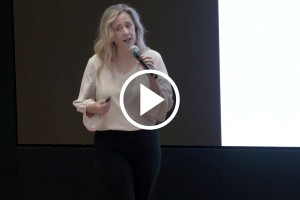
Professor of Humanities and Comparative Literature Katherine Elkins recently gave an invited talk in a conversation for the OpenAI Forum program "Discoveries Across Disciplines" that explored how AI is accelerating academic research.
-

The Department of English and Creative Writing and the Program in Computing are excited to welcome Pulitzer Prize finalist Vauhini Vara to Kenyon.
Kenyon College
Gambier, Ohio 43022