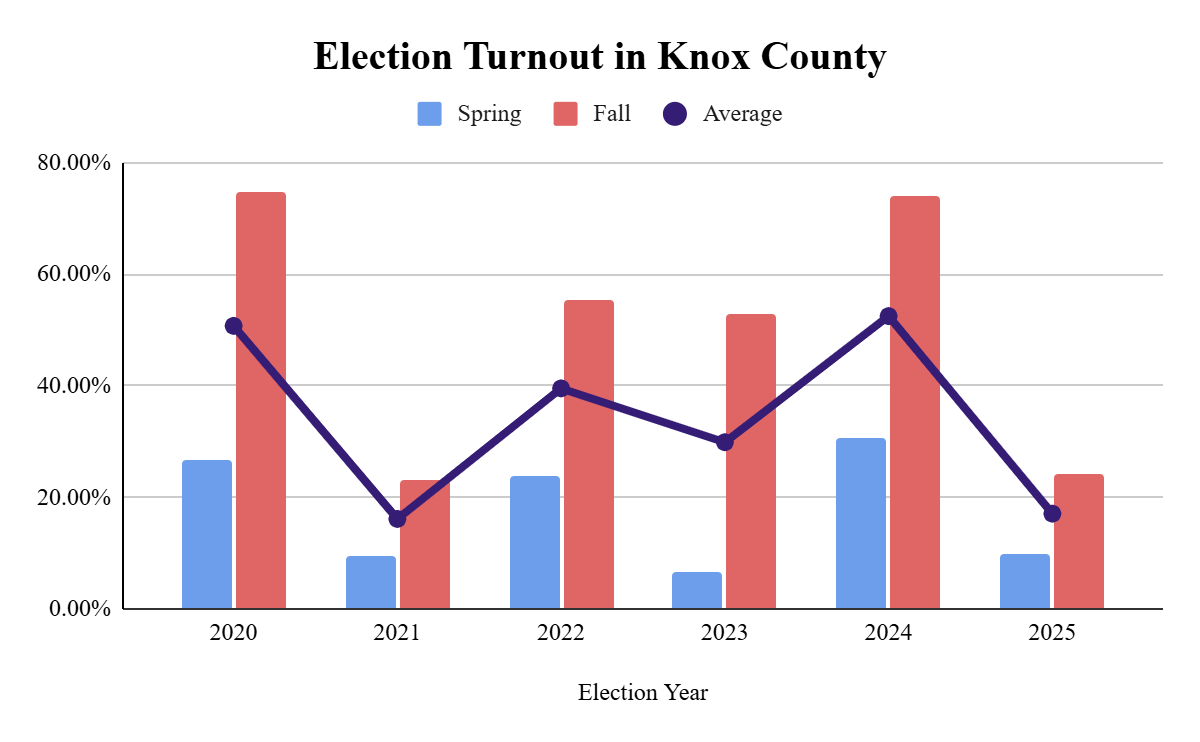
In recent election cycles, CSAD student associates compiled election data to study Knox County elections. “Off-year” election years, when no national contests are on the ballot, present a unique challenge. Turnout is consistently lower. In the last six years, the highest off-year turnout was less than the lowest midterm turnout (see fall 2022 and fall 2023 in figure 1).
This year’s low-turnout data steered us toward an interesting question: for those who do choose to vote in an off-year election, what brings them to the polls? Is it civic-mindedness? Contest-specific excitement? In this analysis, the CSAD Associates explore these (and other) possible explanations for off-year voter turnout.
Election scholars Melissa Marschall and John Lappie have studied local races, election timing, and contestation and the impact of geographic, functional, and socio-demographic factors on contestation1 and turnout.2 These studies suggest connections between place, contestation, and turnout. The CSAD student associates’ analysis makes a small step to address Marschall and Lappie’s critique that contestation “should be featured more prominently in studies of local turnout.”3
Using data provided by the Knox County Board of Elections, we compiled precinct-level turnout percentages. We analyzed the content of each ballot, noting the quantity and type of contests, whether local candidates had competition, and issue/tax levies.
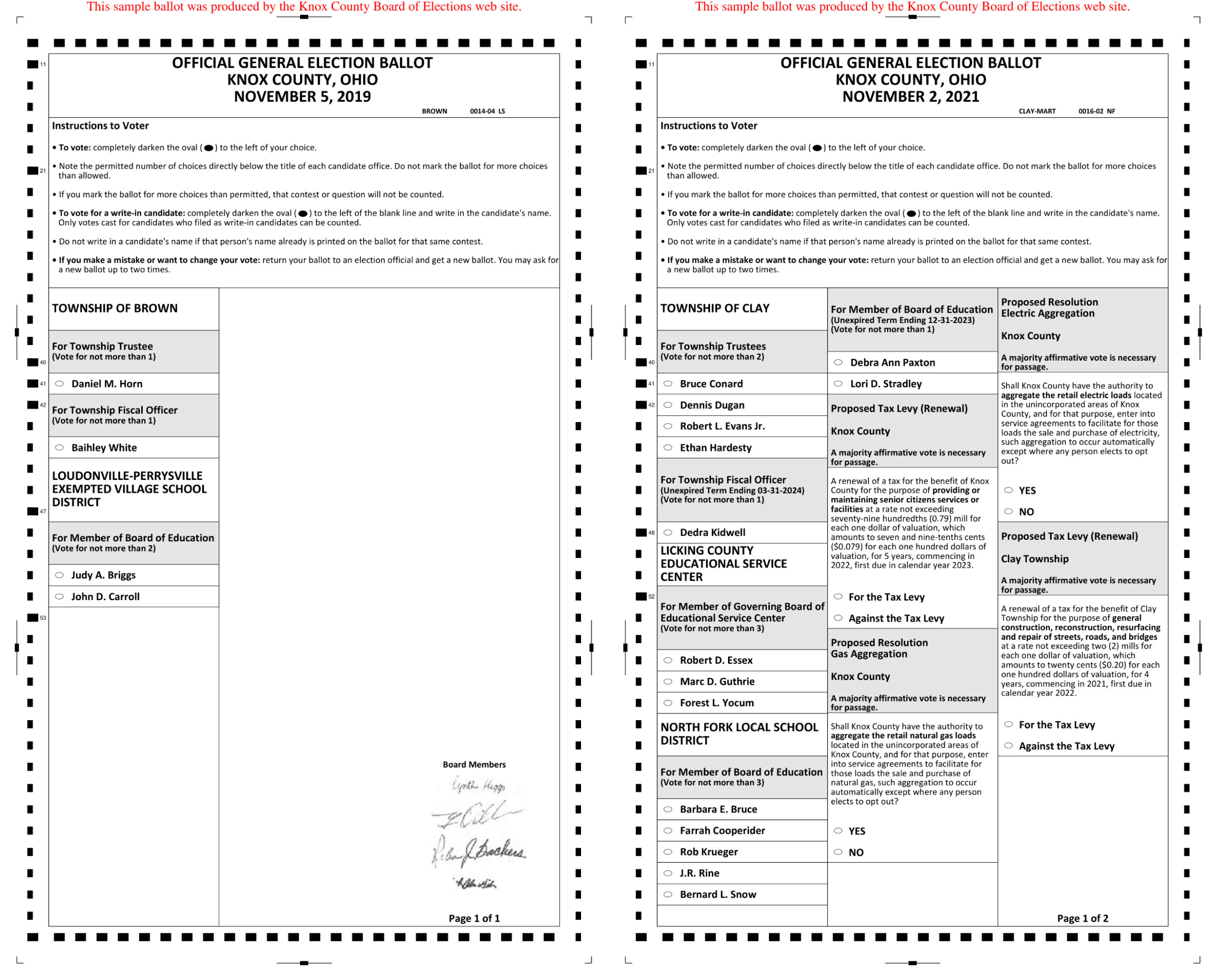
With this data compiled, we compared and contrasted the results of three different off-year elections across more than fifty precincts in the county. The precincts varied in geography, demographics, and partisan composition. In some off-year elections, as many as three offices were contested in certain precincts, while in other precincts, no elections in that year were contested (see figure 2). We hypothesized that in precincts with more contested elections (and those with more tax levies), we would see increased turnout from local voters. Conversely, we expected that precincts with fewer contested races would see less interest from voters and thus lower turnout.
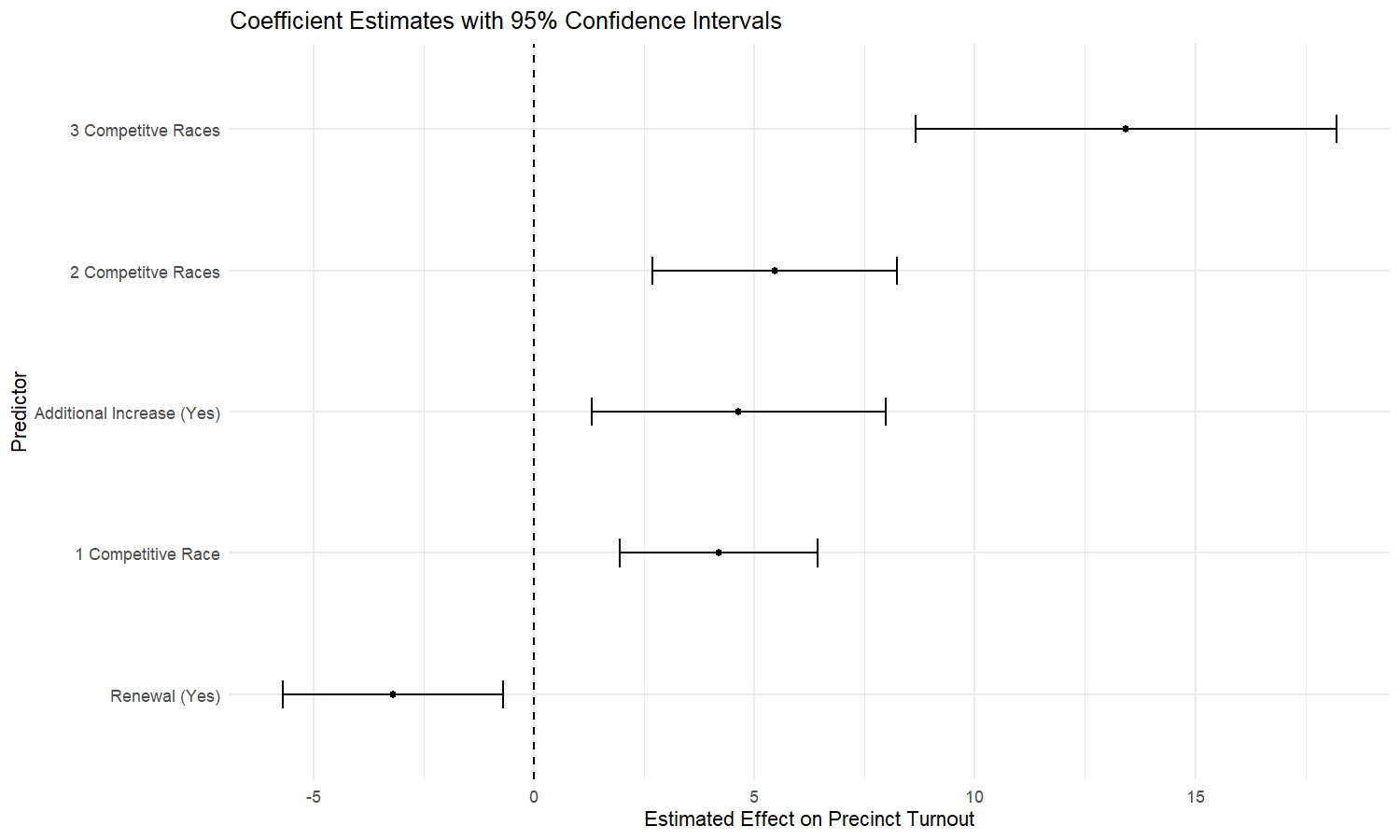
After sorting the data, we ran several statistical analyses and regressions. We found a strong positive correlation between the precinct voter turnout and the number of contested elections on that precinct’s ballot. Likewise, we found significant increases in turnout when levies on the ballot would add new or increased taxes, and lower turnout in precincts with only renewal levies, as displayed in figure 3. In figure 3, the x-axis represents the estimated effect of each variable on turnout, and the y-axis displays several different variables that were tested. These findings demonstrate a relatively strong correlation between the number of contested elections and the turnout in precincts.
While these findings provide support for our hypothesis, they might be fine-tuned by further controls. We did not have data to control for urbanity, ease-of-access to the polling place, and income. And though our data was collected from across three separate elections, we ultimately studied fewer than 200 distinct ballots — a significant but relatively small number of data points.
Nevertheless, our findings suggest a significant correlation between contestation in local elections and voter turnout. We hope that future research will heed the scholarly call for more local election analyses. Here in Gambier, where voter turnout increased in 2024 despite a national decrease, the student associates of the Center for the Study of American Democracy are eager to continue our commitment to civic engagement, at Kenyon and in Knox County at large.
1Marschall and Lappie, “Turnout in Local Elections.”
2Marschall and Lappie, “Place and Participation in Local Elections.”
3Marschall and Lappie, “Turnout in Local Elections,” pg. 225-228.
4This included every precinct and precinct-split in the county for three recent off-year November elections: 2019, 2021 and 2025. 2023 was excluded due to its abnormally high turnout related to controversial issues on the ballot.