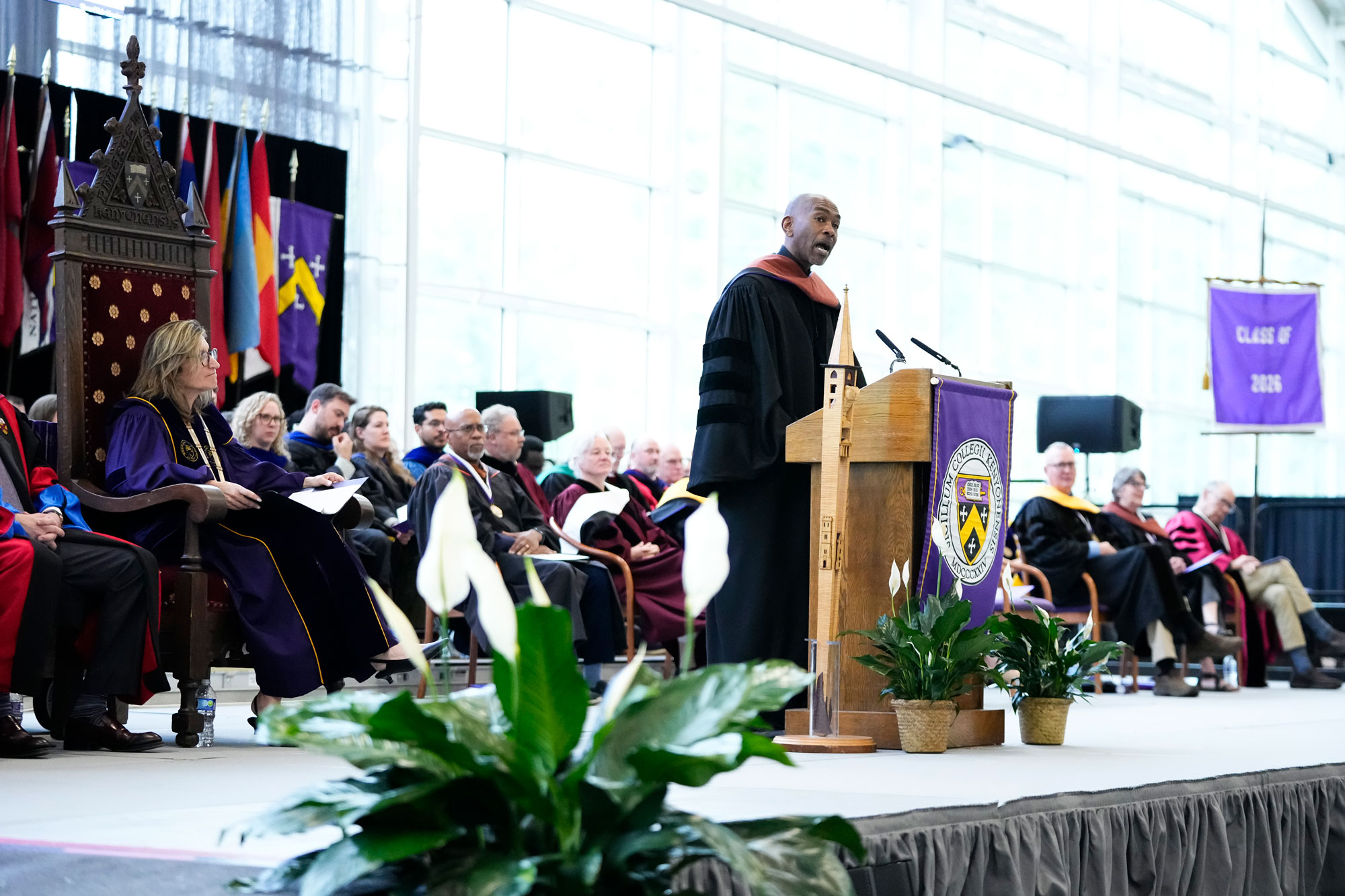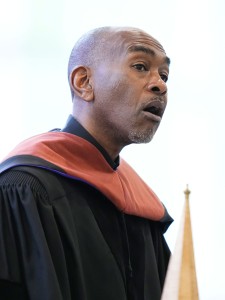
The following is the text of the Commencement address delivered by Paul Tazewell H’26 at Kenyon’s 198th Commencement ceremony on May 16, 2026.
Good afternoon.
It is always a comfort to come here to Gambier — to this campus — because it holds connections that are very dear to me. My brother Jon Tazewell, whom some of you know well, has been a member of your faculty for 29 years. Because of him and his family, I have found a true haven here. This is one of my homes away from home. And so it feels right — deeply right — to be standing before you today, at this particular moment in your lives.
I am honored to join your parents, your loved ones, and the professors who have walked this road with you, as you arrive at one of the most exciting, terrifying, and liberating moments of your lives.
Through diligence, challenge, sleepless nights, some failures, and intermittent bursts of brilliant inspiration — you have arrived.
Here you are.
In the words of Miranda Priestly from “The Devil Wears Prada”: “That’s all.”
Kenyon has given you everything she has. But the most enduring thing she gave you was not from the classroom or on an exam. It was forged in the connections — with the peers, friends, professors — that you built over these four years. Those relationships will continue to shape your life. Honor that network.
Each of you is here because you succeeded. That is not a small thing. You showed up through uncertainty — and that alone is an act of courage.
My invitation to you today is this: Do not spend the next chapter of your life trying to become someone else’s idea of who you should be. Expand into your greatest, most authentic self. That is where your power lies.
When I was 9 years old, my mother gave me a pendant — a modest disc of clear plastic on a leather string, with some groovy 1970s artwork and a message that read: “Be patient, God isn’t finished with me yet.“
Some might have read it as an apology. For me — and I believe for my mother — it was a reminder that I would always live in a process of evolution. Not a weakness. A truth. A private reminder to trust myself, to trust the unfolding.
I carry that quote as a mantra to this day.
Becoming takes time. Brilliance unfolds. You don’t need to have it all figured out today. You are not done yet — and that is not something to fear. It is something to celebrate.
I was born into a loving family in Akron, Ohio — four boys, two parents — at a time of great change. My father migrated from Virginia, earned his degree at Hampton Institute, pursued graduate study at the University of Akron, and became a research chemist at Firestone Tire and Rubber Company. My mother was a native of Akron, raised in a household that honored culture, education, and family above all else.
My maternal lineage can be traced back to an enslaved mother and her freed son. My ancestors fled Jim Crow, passed through Mississippi, and built a life of aspiration and empowerment in Ohio. Creativity was not a career choice in my family — it was the family language. Art and social engagement were not separate in our home; they were intertwined.
My greatest inspiration has always been my mother — a Fulbright Scholar, an educator by profession, and an artist to her core, who remains prolific to this day. She carried all three of those identities at once, and in doing so, she showed me that a life fully lived does not fit into a single category. She gave me the ability to see — artistically, but also to see people with understanding and empathy. She modeled creative problem solving and the power of deep listening.
I tell you this because knowing where you come from is not nostalgia. It is fuel. It is your story — all of it, the complicated parts included — the raw material of your creative authority. The more clearly you understand it, the more powerfully you can lead from it.
Growing up, I wanted to be a puppeteer like Bil Baird and Jim Henson, or a triple threat like Ben Vereen. I also had “psychologist“ on the list. That blend — artistry and the desire to understand what makes people tick — would later define exactly how I approach costume design, how I collaborate with actors, how I tell rich and comprehensive stories through clothing.
I attended the University of North Carolina School of the Arts, earned my BFA in costume design, and went on to NYU for graduate study. Forty years ago, I was sitting in seats much like yours, with no clear picture of what came next. I was entering a profession that was mostly job-to-job, with very few people who looked like me.
For a significant stretch of my early career, I let my artistry speak louder than I would speak for myself. I could dazzle with a costume sketch. But I stood behind that veil — afraid to add to the conversation, hoping my talent alone would prove I belonged in the room.
I felt handicapped in the cultural structure of America. It was conditioning I had absorbed early: Make yourself smaller. Make yourself palatable. Make yourself less threatening — to compensate for how I believed I was literally seen. As the Black, gay man that I am.
That posture served me for a while. I worked hard and I worked often. But I was designing for someone else’s approval, fitting myself into a box that others had built for their comfort, not my capability. That box eventually became too stifling to breathe in.
This is what I want you to hear: That box was never mine to begin with. Do not climb into a box that has been created for you. It took 14 years of a successful career — and a three-year detour teaching at Carnegie Mellon — before I asked myself directly: Why am I doing this? What am I truly invested in? Do I make a difference with what I create?
From that long, honest internal investigation, the answer emerged: My creative voice is original to me and no one else. And the impact I have on every collaborator, actor, director, and maker I work with — that impact is real and it is mine. I had cultivated my own way of working: I develop, I encourage, I inspire in a manner that belongs entirely to me, formed over years of experience and rooted in everything I learned to value from my family and my upbringing.
That is what I want you to find. Not a job. Not a title. Your own way. The one that only you can offer — because it comes from exactly who you are.
The freelance life I had committed to meant perpetual uncertainty. But saying yes — to hundreds of productions, to the unknown, to myself — led eventually to “Hamilton,” then “Harriet,” “West Side Story,” “MJ,” “Wicked” and “Death Becomes Her.”
Patience was not a weakness. It was a practice. And it was only possible because I finally understood who I was working for: myself, and the stories that needed to be told.
When I stood on the stage at the Dolby Theater in Los Angeles in front of millions of people to accept my Oscar for “Wicked,” one of the most profound moments of my life, I realized I was facing a reflection of the man I had been waiting to find. To follow. To emulate. That man was me. I had built myself into a figure of my own inspiration — from the inside out.
In that moment, I was fully seen for who I truly am; A Black, gay man who loves what he does and who he is.
Living fully in this body — my body, exactly as it is — is an act of presence and even of protest. It took me many years to embrace that truth. But I am asking you not to wait as long as I did.
Your identity is not a liability. It is the source of your empathy and your power. Whatever makes you feel most yourself — your background, your culture, your perspective, the specific way your mind works — that is not something to manage or minimize. It is the thing you bring to every room that no one else can replicate.
For me, being Black and gay in America compelled excellence — not because it was required of me, but because invisibility was never an option I was willing to accept. I needed to be seen on my own terms. That urgency sharpened everything.
What is the urgency that sharpens you?
Artists are society’s truth tellers. We reflect, question, challenge and amplify the stories of those who go unseen. In divided times, stories remind us of our shared humanity. That is not a small thing — it is, in fact, the most important thing.
Making a difference is not a grand gesture. It is a daily practice. And it begins with knowing yourself well enough to lead from that knowledge with confidence and conscience.
So here is what I leave with you:
Know your craft deeply. Mastery of your language is what earns you the freedom to break the rules.
Know your story. Walk through the rooms of history and ask: Whose voices are missing? Yours may be one of them. Put it in the room.
Lead by truly seeing others. Listen with intention. Value what people bring. The greatest creative leaders are not the loudest voices — they are the most present ones.
Let curiosity become empathy. Let empathy become generosity. Let generosity become impact. That is the full arc of a life well lived.
Stay open. The opportunity that changes your life will not arrive in the form you expect. Say yes anyway.
Build your community and keep it close. No one does this alone. Your network is your lifeline and your mirror.
Seek the analog. Sit in libraries. Have unfiltered conversations. Sit in discomfort — that is where growth lives.
And remember this above all: your degree is not simply permission to create and lead boldly. It is a responsibility to create and lead with conscience.
You know who you are. Now go live that truth — fully, fearlessly, and on your own terms.
Life is a gift. The world needs exactly what only you can give it.
Congratulations, Class of 2026.