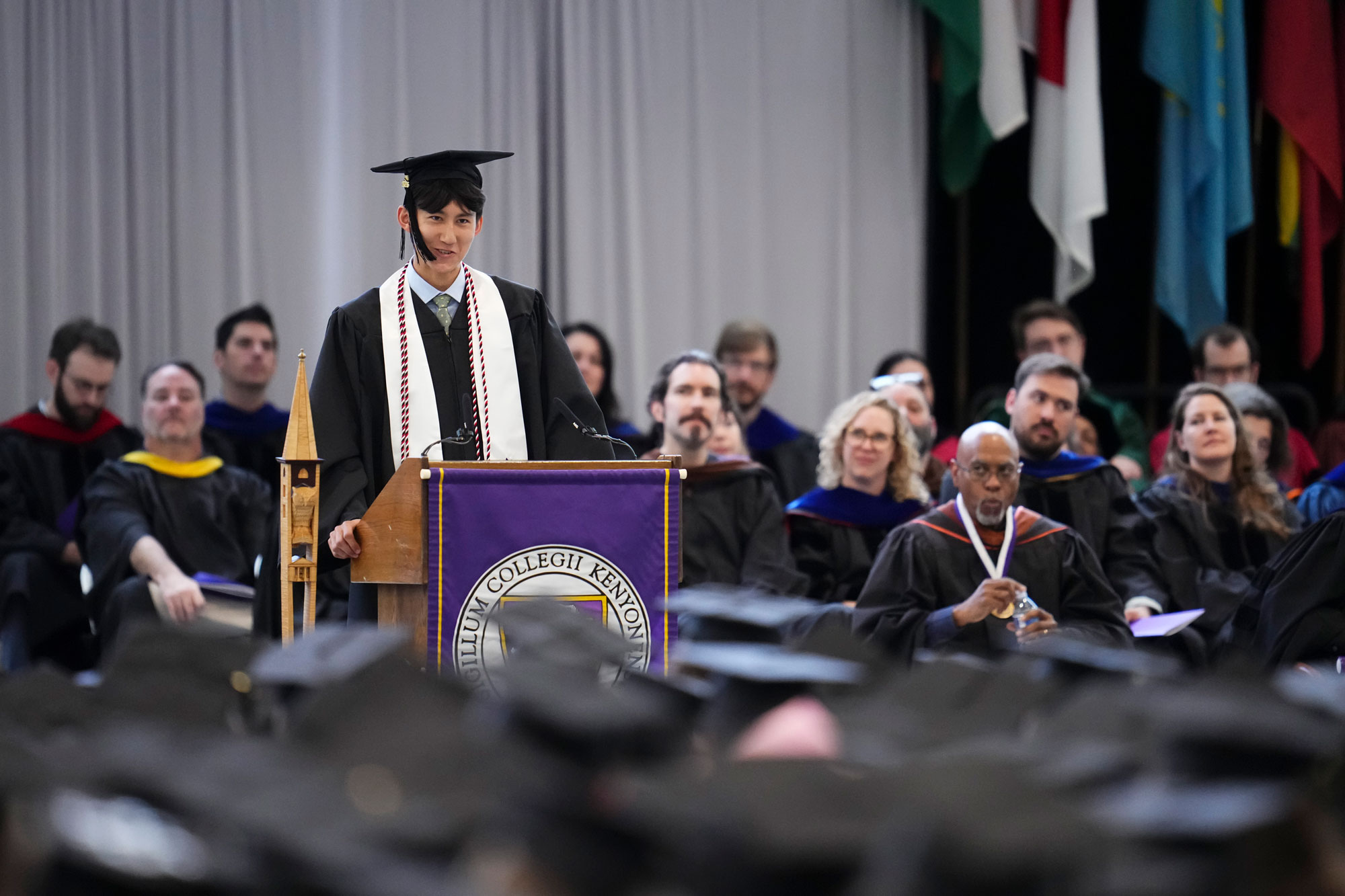
The following is the text of the Commencement remarks delivered by Senior Class President Dylan Sibbitt ’26 at Kenyon’s 198th Commencement ceremony on May 16, 2026.
Good morning.
Kenyon is perhaps as self-selective as it is selective. To come here is not only to be chosen, but to choose something slightly improbable. To choose to study among the cornfields is a decision. To live in a village where your social, intellectual, athletic, emotional and occasionally romantic lives all unfold within a few hundred acres is a decision. To voluntarily spend four years in a place where the most traveled road in the community is a 10-foot-wide gravel path requires a certain willingness to believe.
And four years ago, we made that decision.
It feels just like yesterday that we arrived for orientation, when Kenyon resembled something like Oxford summer camp. The Ohio sun beat down with great and unnecessary force. Our families helped unload cars. We kicked rocks out of our shoes and pretended not to be nervous. We walked up and down Middle Path as if we understood where anything was. And for a moment, anything felt possible.
The summer before Kenyon, I read “Looking for Alaska” by John Green, a Kenyon alumnus who, I am obligated to mention, gave a commencement address here that set an extremely unfair standard for the rest of us. In that novel, the main character, Pudge, says of leaving home for boarding school: “The Great Perhaps was upon us, and we were invincible.”
We arrived with that strange and beautiful optimism that belongs mostly to the young: the belief that we would become smarter, better, more interesting versions of ourselves, but preferably without too much embarrassment along the way. We imagined college as transformation, which it was. We imagined it as adventure, which it also was. What we perhaps did not imagine was how much of that transformation would happen not in the grand, cinematic moments, but in the ordinary ones.
We watched Middle Path turn green, then gold, then gray, and then somehow green again. We learned that Peirce breakfast is both a meal and a moral achievement. We learned that Chalmers is beautiful, but that no library can save you from a paper you started too late. We braved New Side alone. We danced at the Horn Gallery, Fandango, and Senior Soirée. Our classmates won national championships and Fulbrights, made art, published research, performed on stages, and led organizations. Some of us, under the torturous guise of a sport called cross country, voluntarily logged unreasonable mileage on the country roads of rural Ohio, for reasons still not fully clear. We became the inaugural class of the Owls, a historic transition the bookstore accepted with remarkable speed.
And somewhere in all of this, we were loved. Not always loudly, and not always in ways we recognized at the time, but consistently. By friends who stayed up too late with us. By professors who took our ideas seriously before we fully knew how to take ourselves seriously. By coaches, advisors, mentors, and staff members who challenged us, forgave us, fed us, noticed us, and kept this place going. I hope we will not forget the kindness and generosity of those on this hilltop who were kinder and more generous than they needed to be.
Because I think this is what we did not understand at the beginning. We thought the Great Perhaps was waiting somewhere ahead of us — after the next class, the next season, the next application. But much of it was already here: in the ordinary, ridiculous, generous life we built together on this Hill.
And now, Class of 2026, we stand again at a Great Perhaps.
Perhaps we no longer feel as invincible. Perhaps that is a good thing.
But we know, now, what it is to be changed by a place, and by one another. Thank you.