When R. Jordan Crouser started this summer as the founding director of Kenyon’s new interdisciplinary program in computing, faculty members and administrators offered plenty of input — but he felt like he needed more.
So Crouser asked his students for help.
“What I realized I was really missing was a group of student voices to help me think through what this program needs to look like,” he said.

Over the course of the fall semester, 10 students in Crouser’s special topics seminar, “Introduction to Design Thinking,” helped build a better picture of what a forward-thinking program consistent with the College’s values, existing coursework in computing, and student needs could be.
The group’s recommendations have helped guide Crouser’s approach to the program, suggesting that it be broad-based and widely accessible to underclassmen and nonmajors. This input directly impacted this spring’s curriculum.
“Students made a compelling case that a defining feature of a Kenyon computing program should be early access to intellectually exciting topics, and that we should design for the reality that most students will not major in COMP,” Crouser explained.
That led him to offer a new class this spring, the special topics seminar “Contemporary Topics in Computing,” which focuses on digital security in a way that intentionally spans hardware, software and human systems without requiring a deep prior background in computing.
“Very few institutions offer a course like this at such an accessible entry point, and it’s a concrete example of how student feedback translated into an immediate teaching decision,” Crouser said.

Elizabeth Aiken ’26 took Crouser’s design class despite having never taken a computing class before at Kenyon. She said the group took its work seriously and was excited for its input to be considered by the College.
“I was constantly impressed with and inspired by the recommendations that my classmates made. It was exciting to feel everyone’s energy for the new computing department,” she said. “And it was special that Jordan trusted us enough with our insights about Kenyon students, values and academics to value our opinions so highly.”
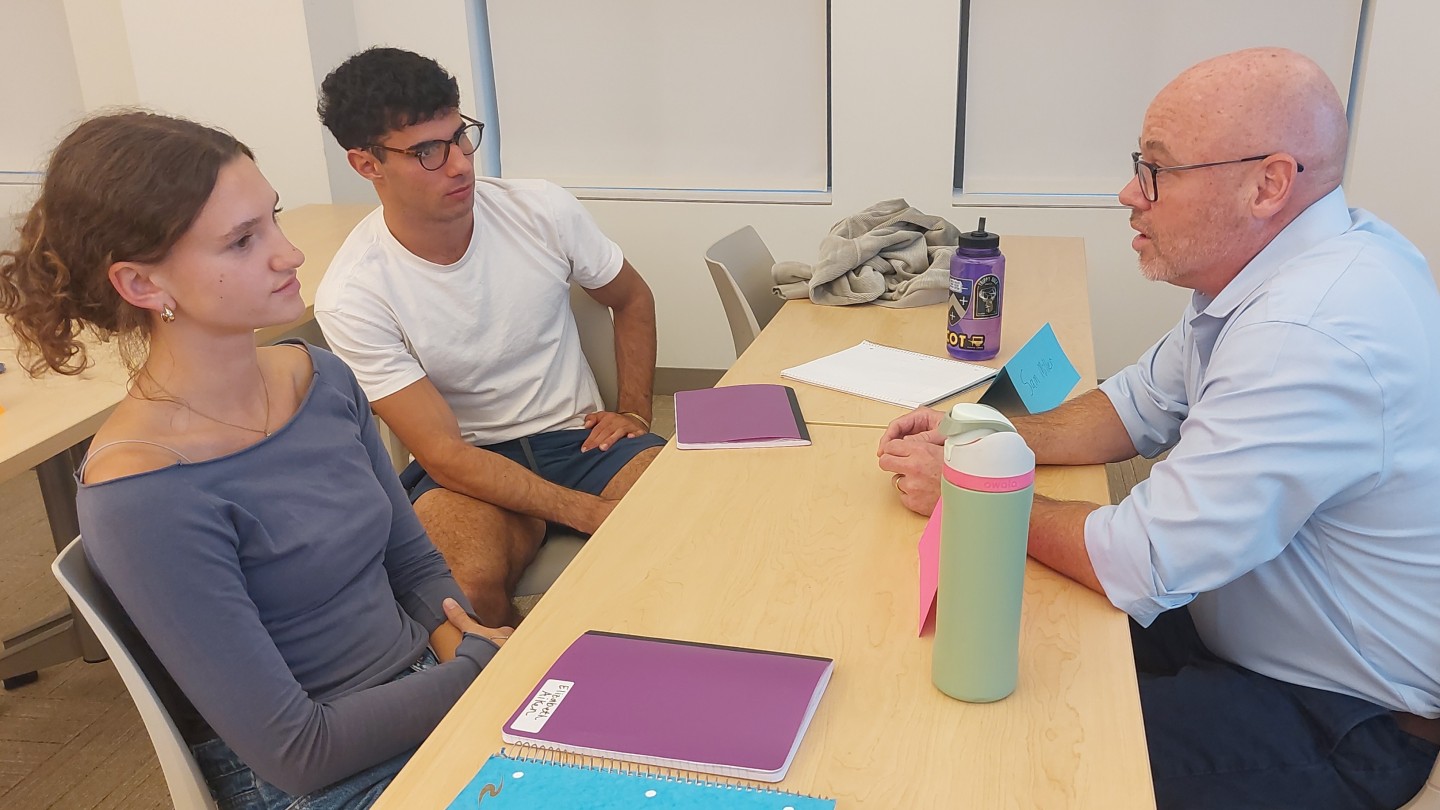
The class’s process also involved curriculum mapping, competitor analysis and extensive stakeholder interviews that included conversations with administrators like President Julie Kornfeld, faculty and staff.
To help the class better understand the interdisciplinary possibilities involved, students created a “course remixer” that allows users to make mash-ups of any pair of Kenyon classes. And as a final project, the class — which recommended student representation on the program’s steering committee — built an “Oregon Trail”-style video game that lets people explore various governance structure decisions and their potential ripple effects.
“We went through all of the typical things you’d see in an ‘Intro to Design Thinking’ course — How do you map your stakeholders? How do you understand systems of constraints? — but we learned all of that in the context of thinking about how we would design a program in computing that’s not traditional computer science and is distinctly Kenyon,” Crouser said.
The overall conclusion was that the College should prioritize accessibility, allowing a wide variety of students to take certain classes without having to run a gauntlet of highly technical prerequisites first.
“That’s our secret sauce,” Crouser said. “You get to do all of the cool stuff upfront. … I think that’s an amazing model, and I think it would be very, very attractive to students who are considering Kenyon.”