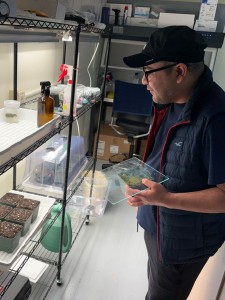
Kamesh Regmi in his Higley Hall lab.
Plant biologist Kamesh Regmi has long been interested in figuring out how to improve crop productivity to better feed the billions of people on Earth.
Using quinoa — a superfood containing all nine essential amino acids — and other vegetation growing either in the greenhouse or his lab at Higley Hall, he’s spent years investigating sugar transport in plants, a process that he said holds the key to making them more productive to sustain a growing world population.
Now, the assistant professor of biology is expanding his focus to include those who might one day live on another world — Mars.
With the assistance of three students, Regmi has been conducting experiments this semester examining how quinoa grows in simulated Martian regolith — the layer of dust, broken rock and more that covers the Red Planet’s surface.
“I work with plants that are going to be very important to having a sustainable supply of food for a growing human population,” Regmi said. “NASA shortlisted quinoa as one of the plants that it would like to explore as part of what it refers to as Controlled Ecological Life-Support System experiments (CELSS). We’ve been studying quinoa in the lab that I teach every year, so it was just a natural progression to go from growing quinoa on Earthen soil to a Martian one.”
Quinoa is a perfect candidate for closer study, he said, because its entire genome has been sequenced, it is a naturally stress-tolerant species, and it has a strong nutritional profile.
“There’s not enough published literature about quinoa in general, so whatever we learn about it in terms of sugar transport will be completely new,” he said. “We wanted to go a step further and see the effect on sugar transport if we grew quinoa on a Martian regolith.”
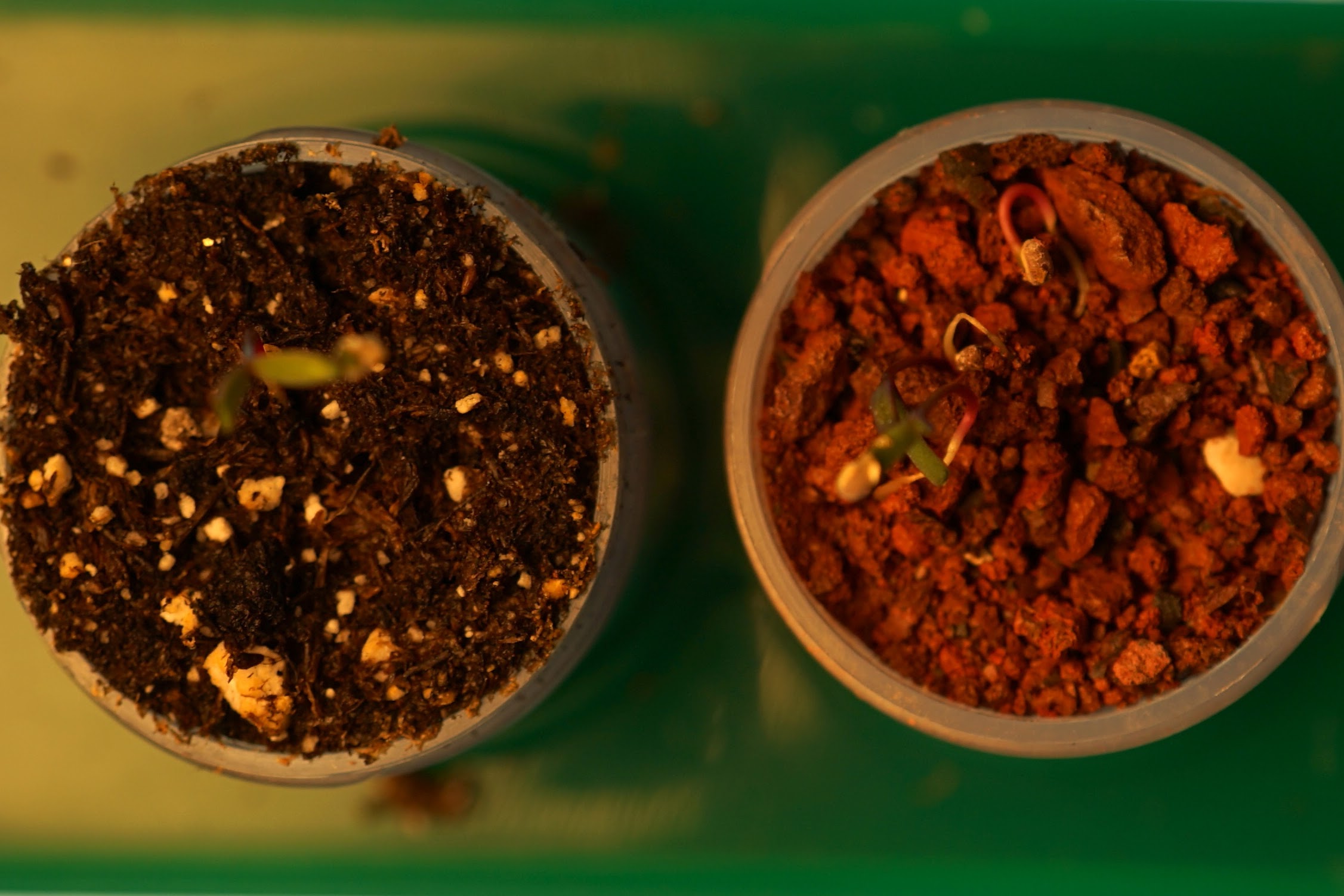
This semester, Regmi led experiments investigating how the plant would grow in typical soil compared to a simulated Martian one. (Rovers have analyzed the planet’s famously red regolith, but none of it has made its way back to Earth yet.) In initial trials, the seeds germinated but did not take root.
In the coming weeks, he plans to expand the inquiry by incorporating varying amounts of compost into the regolith, which is otherwise inorganic and dusty. His team will supplement it with fertilizers like earthworm waste (vermicompost) and mycorrhizae, symbiotic fungi that can extend the reach of plant roots. They’ll also try watering from below rather than above, since liquids have difficulty making their way through the powdery regolith.
Regmi said this work is not funded by NASA but should add to researchers’ overall understanding of sugar transport in the plant in addition to possible out-of-this-world applications. It has been informed by a recent study published March 5 in Scientific Reports of other researchers growing chickpeas from simulated lunar regolith.
Subin Kim ’26 said she’s excited to work with Regmi as an undergraduate on research with such far-reaching implications.
“When he brought up something about Martian soil, I thought it was something that was only possible in a sci-fi movie or in graduate school programs,” she said. “Everything we’re doing here is new to everybody. We are learning as we are going through ups and downs, all those mistakes and successes. Everything about it is just so fascinating!”
The other two students helping Regmi — Elisa Lybarger ’29 and Casey Landers ’29 — are paid researchers funded through the biology department’s Pathways to Research program for students who have not had prior research experience.
Lybarger, a prospective neuroscience major, said she’s proud to be part of work that could have important applications — here on Earth or, one day, on Mars. The experience has helped her approach to science more broadly, too.
“This has helped me become more confident in doing lab work so that I would look into doing it more with the neuroscience department.”