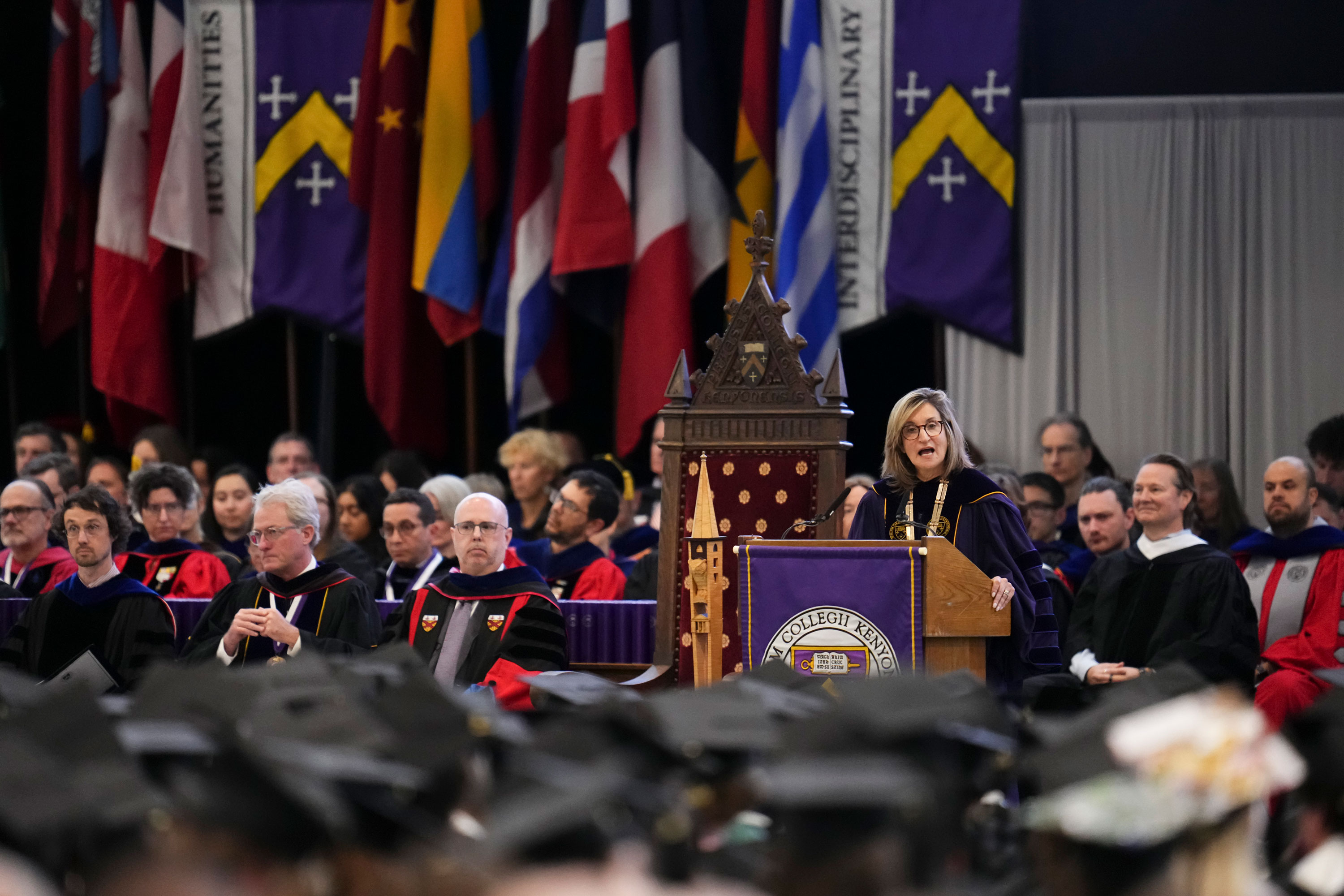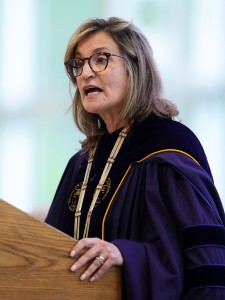
The following is the text of the address delivered by Kenyon President Julie Kornfeld at the College’s 198th Commencement ceremony on May 16, 2026.
Good morning and welcome once again to the members of the Class of 2026 and your honored guests. It is wonderful to be with all of you. We are here this morning to celebrate you at the culmination of your liberal arts journey. And while we must spend some time today looking back, I’d like to begin by looking ahead. Because the two are bound together.
I’ll start with some forward-looking questions that may be on your mind: How do I navigate in a world that is changing so rapidly? What does this mean for me and my career? For the passions I hope to pursue?
We have lived through a time when many in the world believed in specialization. A time when deep technical skills guaranteed you a job and career security. That belief is being fundamentally disrupted as we sit here. Yet I remain convinced that as technology like AI transforms the workplace and the world, a liberal arts education is and will continue to be the most strategic and important preparation for long-term life and career success.
I’ve been thinking about this a lot lately. There’s a book that I read recently that I found to be very insightful. It’s by David Epstein, and it’s called “Range: Why Generalists Triumph in a Specialized World.” After examining some of the most successful athletes, artists, musicians, inventors and scientists throughout history, Epstein concluded that the secret to success isn’t just depth of knowledge — or specialization — it’s the ability to juggle many interests, make more connections, think more nimbly. From tennis legend Roger Federer — who played many sports growing up before he focused on tennis — to revolutionary thinker Charles Darwin — who studied medicine and theology before natural history — he found it’s a pattern that emerges again and again.
Which means that maybe all those hours practicing one skill, preparing for one job, isn’t quite the time well spent that traditional thinking says that it is. In the world you’re about to enter, what matters most is not what you know, but how you think. This is a world that demands that individuals ask good questions, synthesize complex information across disciplines, write clearly, speak persuasively and understand human relationships.
These are not “soft” skills — these are essential skills. And, they are the heart of a Kenyon education. An education that cultivates the capacity to step into the unknown, to sort through complexity, and respond with clarity and empathy. As Epstein writes in his book, “Modern work demands knowledge transfer: the ability to apply knowledge to new situations and different domains.”
But, of course, you know this. You came here betting on a liberal arts education that would teach you to think about more than one thing in more than one way. And here’s a little secret that results from that approach: Kenyon is not just designed to prepare you for the job or the graduate program that you’re going to start this summer — although we have. To those of you who are starting your next thing right away, you are going to do great. We know this.
But, what Kenyon and your liberal arts education is really designed to do is to prepare you for the next 40 years. For the career you’re interested in now and the one you don’t even know you want to be your life’s work yet. Perhaps, even, for the one that hasn’t even been invented yet. We’re here to prepare you for a fast-changing world that will require you to do many things and to be many things.
That is the beauty of a Kenyon education. It’s about more than checking off a set of boxes for certain skills. That is far too limiting. It is a launchpad that will set you on your way while supporting your ability to make course corrections as you pivot into business or technology or the arts or government or media or healthcare — or maybe, at some point, all of them.
That’s what happens when you learn how to think broadly, delve deeply, collaborate widely, act nimbly and adapt quickly. It gives you range. As Epstein writes, “In an increasingly complex and rapidly changing world, the ability to adapt is more important than technical proficiency.”
It’s a great point — and one he easily could have made with a version of his book based entirely on Kenyon graduates. Consider John Green from the Class of 2000. You probably know him for his popular young adult novels and his YouTube channel, but Green — who majored in English and religious studies here and once wanted to be a minister — has also transformed public health conversations through his advocacy and writing.
You want someone more recent? How about Arjav Ezekiel, Class of 2010, who has made a name for himself as a James Beard Award-winning restaurateur. Not bad for a political science major with no formal hospitality training who is now leading a movement that goes well beyond the Austin restaurant he founded with his wife. With his Kenyon education, he’s helping to reshape the hospitality industry by insisting on an equitable, employee-first philosophy.
Still feel a bit remote? How about someone even more recent? How about one of you? That’s right, each and every one of you would feel right at home in the book “Range” because you all are examples of people who are more than one thing, and who, therefore, can do more than one thing.
Let’s start with a few of examples of students who won some of our most recent College awards. I’m talking about you, Christiane Betfarhad: president of Student Council and co-president of the Owl Creek Singers, member of the rugby club, Chamber Singers and — not to be overlooked — the “Rocky Horror Picture Show” shadow cast. And I’m talking about you, Julius Lavon Thompson II: a psychology major, football player and track athlete who served as co-president of the Black Student Union and vice president and housing manager of Men of Color. Or how about you, Ethan Manske, an environmental studies and Japanese double major who played with the Knox County Symphony and was a decorated swimmer, earning an NCAA postgraduate scholarship.
If we had the time — and I don’t — I would do this 483 more times. Because you are all more than one thing. And because of that, you are all ready for what’s to come.
So, what is to come? The truth is, I don’t know. No one does. In a world where old systems are faltering and the only constant is change, it’s impossible to say what tomorrow will look like. But what I can say is that the fundamental qualities — the human qualities — that you have nurtured here and that you will carry with you are the qualities that will set you apart and foster your success in whatever you do.
I would be remiss if I didn’t mention something else worth carrying with you: your relationships developed here. I have watched you interact — in classrooms, in conversations along Middle Path, and at the senior dinners that Fred, Milo and I have hosted at Cromwell Cottage. You challenge one another, you celebrate one another and you support one other. You indeed show up for each other. Your dedicated faculty and mentors and coaches who have guided you here have done the same — asking more of you when you were ready to be pushed and encouraging you when you needed support.
That spirit of mutual investment is what makes this community unique. You have spent four years here engaging in community in the fullest sense of the word. You didn’t just participate in campus life — you shaped it. You staged plays, gave concerts, built organizations and new traditions, and created spaces where people felt supported and included. One way or another, you found your people and built a community that will sustain you long after you leave this special place.
I hope, with all this in mind, you can approach this rapidly changing world with confidence, not fear. Any time society changes or is disrupted, something else must rise to take its place. You will be the ones to build that. You are the architects of tomorrow. And, having gotten to know so many of you, I can say with confidence that tomorrow is in really good hands.
You know how to keep learning — how to move across disciplines, engage in complex problems, and contribute meaningfully in unfamiliar situations. And, just as importantly, you have learned how to do that work collaboratively with other people. That should not only be a source of confidence; it is a lasting advantage.
There remains a lot of good in the world. You’re proof of that. I know you’ve seen it in yourself and each other, and I have, too. When I look out at all of you, I am filled with nothing but hope and joy. I see a community of agile and bright minds ready to take their place in the world, ready to work together for a better world, starting right now. So as you take your next steps, know that the Kenyon community will always be there for you. That the faculty sitting behind me and your friends sitting next to you will be here for you. I wish you the best of luck and hope you’ll return to Gambier often and visit.
Congratulations!