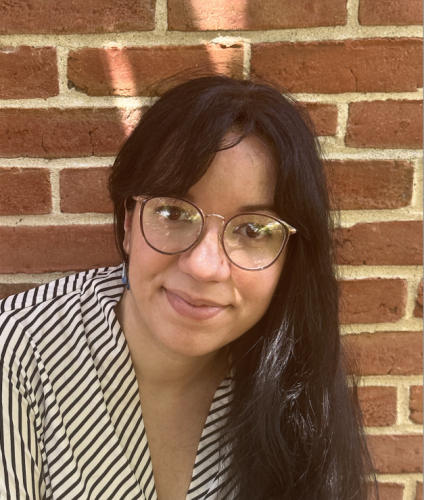
Sahai Couso Díaz joined the Department of Modern Languages and Literatures faculty in 2024. She received her joint Ph.D. in Spanish studies and comparative media analysis and practice from Vanderbilt University in 2023. She was a Hastac Scholar, a 2020-2021 Andrew W. Mellon Fellow for Digital Humanities and a 2022-2023 fellow at the Robert Penn Warren Center for the Humanities at Vanderbilt University. She held a visiting position at Williams College and taught at her alma mater, the University of Havana, Cuba.
Her research and teaching interests include race, science, literature and museum studies in Latin America and the Caribbean during the colonial period and beyond. Her interests stretch far and wide as she is also drawn to media studies, visual culture and emerging technologies. Her essays have appeared in Bulletin of Hispanic Studies, Chasqui and Confluencia.
Areas of Expertise
Eighteenth to twenty-first century Spanish and Latin American literature and media, transatlantic and hemispheric studies, museum studies, ethnic and race studies
Education
2023 — Doctor of Philosophy from Vanderbilt University
2019 — Master of Arts from Vanderbilt University
2013 — Bachelor of Arts in Hispanic Literature from the University of Havana
Courses Recently Taught
This first half of a yearlong course is focused on the self in a broader social context for students who are beginning the study of Spanish or have had minimal exposure to the language. The course offers the equivalent of conventional beginning and intermediate language study. The first semester's work comprises an introduction to Spanish as a spoken and written language. The work includes practice in understanding and using the spoken language. Written exercises and reading materials serve to reinforce communicative skills, build vocabulary and enhance discussion of the individual and community. This course includes required practice sessions with a teaching assistant, which are scheduled at the beginning of the semester. Students enrolled in this course are automatically added to SPAN 112Y for the spring semester. No prerequisite. Offered every year.
This second half of a yearlong course is a continuation of SPAN 111Y. The second semester consists of continued study of the fundamentals of Spanish, while incorporating literary and cultural materials to develop techniques of reading, cultural awareness and mastery of the spoken and written language. The work includes practice in understanding and using the spoken language. Written exercises and reading materials serve to reinforce communicative skills, build vocabulary and enhance discussion of the individual and community. This course includes required practice sessions with a teaching assistant, which are scheduled at the beginning of the semester. Prerequisite: SPAN 111Y or equivalent. Offered every year.
This first half of the yearlong intermediate-level language course is focused on language and culture for students who are interested in developing their ability to speak, read, write and understand Spanish. In addition to a comprehensive grammar review, the primary texts chosen for the course serve as a general introduction to Hispanic culture and literature. Other materials include short essays, newspaper articles, films, television series and songs, which together provide a point of departure for discussions on a range of issues. This course includes required practice sessions with a teaching assistant, which are scheduled at the beginning of the semester. Students enrolled in this course are automatically added to SPAN 214Y for the spring semester. Prerequisite: SPAN 111Y-112Y or equivalent. Offered every year.
This second half of the yearlong intermediate-level language course builds on the concepts and skills addressed in the first semester, with a continued focus on language and culture for students who are interested in developing their ability to speak, read, write and understand Spanish. Students are exposed to more complex Spanish grammar while also expanding their vocabulary in context, using authentic materials similar to those of the first semester (including short novels, stories, essays, newspaper articles, films, television series, and songs). Students produce more advanced analytic and creative writing assignments, and are asked to actively discuss a range of challenging topics in class with increased proficiency (compared to fall semester). Like SPAN 213Y, this course includes required practice sessions with a teaching assistant, though the days and times for these may be different from the fall semester. Prerequisite: SPAN 213Y or equivalent. Offered every year.
This course uses literature and film to give advanced students the opportunity to strengthen their ability to write analytically and creatively in Spanish. The course also strongly emphasizes speaking and reading in Spanish. Works from various literary genres and selected Spanish-language films are among the materials on which class discussion and writing assignments are centered. To deploy this content, we use digital technology that supports the acquisition of advanced vocabulary, the development of reading comprehension and writing. A grammar review, focused mainly on typical areas of difficulty, may also be included. Prerequisite: SPAN 213Y-214Y or equivalent. Offered every year.
This course studies a significant, provocative selection of films from Latin America. This cultural production, despite its lack of international visibility until recently, has a long and complex history that merits consideration. Students have the opportunity to see the present-day region and the forces that have shaped it through images generated from within its cultures. They are exposed to an art that is revolutionary because of its form and the ways in which it challenges the cinematic methods and styles of creation that characterize Hollywood's cultural industry. It uses as a theoretical basis a range of cultural, gender, ethnic, queer and postcolonial perspectives as they apply to cinema. We consider films directed by "El Indio" Fernandez, Buñuel, Birri, Gutiérrez Alea, Rocha, Sanjinés, Ledouc, Lombardi, Subiela, Gaviria, Bemberg, Salles and Cuarón, among others. This course is recommended for majors in Spanish or international studies. Prerequisite: SPAN 321 or equivalent. Generally offered every three years.
This course presents an overview of the Spanish American short story from 1940 to the present. It examines the antecedents of the new Spanish American narrative, the so-called "Spanish American Boom," and a narrative of the periphery. The national literature of the "boom" is read with attention to subgenres such as the fantastic, magic realism and the marvelous real. It shows how these subgenres are transformed and eventually challenged by an ethnic, feminine and postmodern narrative, which instead of focusing on the representation of the nation explores other social subjects and forms of cultures. Among the authors included are Jorge Luis Borges, Juan Rulfo, Julio Cortázar, Carlos Fuentes, Gabriel García Márquez, Luisa Valenzuela, Isabel Allende, Ana Lydia Vega, Diamela Eltit, Ricardo Piglia and Elena Poniatowska. Prerequisite: SPAN 321 or equivalent. Generally offered every three years.