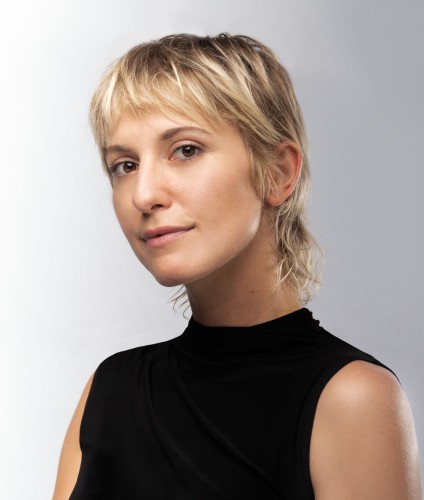
Julianna (Jules) Johnston is an interdisciplinary artist, performer, and assistant professor of art and new genres. Their practice integrates media, performance, installation, and experimental pedagogy to explore how play and embodied engagement can unsettle and reframe personal and collective relationships to digital interfaces and surveillance technologies.

Their work has been shown across the U.S. and internationally, including at Slamdance Film Festival, Athens Digital Arts Festival, Rathaus für Kultur (Switzerland), Studio Hüette (Berlin), Spectra Studios, and Human Resources (Los Angeles). They have been an artist-in-residence at DOGO Residenz für Neue Kunst, Crosstown Arts, Mass Gallery, and Vermont Studio Center. Previously, they taught in the Department of Media Arts at UCLA and directed the Oxbow School Summer Art Institute.

Areas of Expertise

Media art, installation, performance, video

Education

2024 — Master of Fine Arts from Univ of California Los Angeles

2018 — Bachelor of Fine Arts from Rhode Island School of Design

Courses Recently Taught

This course enables students to explore digital media while engaging in aesthetic and conceptual practices in contemporary art. They come to understand the fundamentals of visual form and to develop technical skills with a variety of camera and computer tools, including still-image and video-editing programs. Personal studio projects cover a variety of subjects, such as the relationship between the arts, popular culture and the liberal arts; the historic role of technology in the arts; and the role of one's cultural and historical context in the creation and interpretation of artwork. Through theory and practice, students enhance their art-criticism skills, allowing for productive group interactions and the defining of personal aesthetic vision. Presentations and demonstrations by the professor are supplemented by student research and response to contemporary artists and issues. At least 10 hours of work per week outside of class is required. This counts toward the introductory course requirement for the major. No prerequisite. Offered every semester.

This course allows students to explore art that is based on a merger of space and time and on a relationship between the artist and the visitor. Perhaps the most inclusive and pervasive art form in the last 40 years, installation art has roots in cinema, performance art, set design, architecture, graphic design, land art, public art, curating, art criticism and history in addition to the more traditional visual arts. In this class, students create immersive environments that are either site-specific or nomadic. They also have the opportunity to integrate performance, video and audio components in their projects. Components range from everyday objects to surveillance video, from large wall drawings to interactive switches for participants to manipulate. The class consists of demonstrations of art skills particularly useful in installation (sculptural, video, audio, graphic presentation and so on), presentations, readings, weekly critiques and cumulative projects. Previous experience with any creative media such as writing, dance, music or performance is helpful. This counts toward the intermediate course requirement for the major. Prerequisite: ARTS 102, 103, 106, or 107. Offered once a year.

In this course, students experiment with the creation, manipulation and exhibition of digital film and sound projects. In doing so, they continue a tradition from early filmmaking, in which abstract montage, surreal fantasy and playful narratives reflected innovations in the art, science and politics of the time. Like many current artists and filmmakers, students follow the example of these historical trajectories by using contemporary technologies and concepts for acquisition, post-production and distribution of their work. Demonstrations of a wide range of equipment and software are provided, from low-tech to high-tech. Research of historical/cultural forms offers a context for the assignments. Frequent critiques offer important feedback. This counts toward the intermediate course requirement for the major. Prerequisite: ARTS 106 or ARTS 107. Offered every other year.

This first semester of a two-semester sequence is designed to enable students to develop their personal artistic vision based on the foundation of introductory and intermediate studio art courses. Students are expected to develop a self-generated body of creative work based on a concentrated investigation of materials, methods and ideas. They develop oral and written presentation and research skills as they work toward a professional exhibition in the second semester. Critiques, discussions, presentations and readings provide context and feedback for this process. Students learn to develop the elements necessary for professional exhibition of a cohesive body of work, including developing ideas, writing an artist's statement and resume, and perfecting presentation skills. Studio art majors are expected to take this class and ARTS 481 with two different faculty members. This course is required for studio art majors. Senior art majors only. Offered every fall.