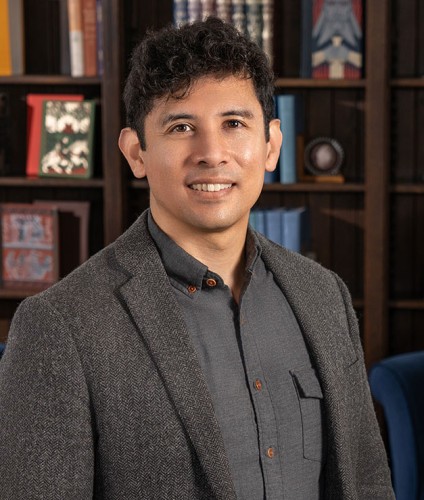
Celso M. Villegas joined the Kenyon community in 2011 as the Mellon Postdoctoral Fellow in International Studies. Trained in comparative-historical analysis, he has published on middle-class formation and democracy in the Philippines, Ecuador and Venezuela. His current research expands on the theme of democratic change through the lens of cultural sociology: the meanings of social class, ritual and political performance in U.S. politics, and civil sphere theory around the world. He was a visiting fellow at the Yale Center for Cultural Sociology in 2017 and has been book reviews and associate editor of the American Journal of Cultural Sociology since 2022.

In 2025, Villegas began a three-year term as the Kenyon National Endowment for the Humanities Distinguished Teaching Associate Professor of Sociology. His project is focused on how to provide intellectual resources to students and to society-at-large on how to read each other with faith instead of suspicion, and to find joy and surprise in the social world.

He teaches courses on a variety of topics in both sociology and international studies: sociological theory, economic sociology, cultural sociology, collective memory, comparative democratization, and civil society.

Areas of Expertise

Sociology of development, comparative and historical methods, social change, political regimes, class formation, the Philippines and Latin America

Education

2012 — Doctor of Philosophy from Brown University

2005 — Master of Arts from Brown University

2003 — Bachelor of Arts from Connecticut College, summa cum laude

Courses Recently Taught

This seminar examines some of the problems inherent in cross-cultural comparison and explores the ways in which a variety of disciplines grapple with these difficulties by investigating contemporary themes in international affairs. These themes include some or all of the following: ethnic conflict; comparative perspectives on development; religion and socioeconomic development; contemporary environmental problems; the ethics of armed intervention; the emergence of a world popular culture and its consequences for national cultures; the challenges of democratization; and perceptions of the United States, Americans and U.S. foreign policy abroad. Open only to international studies majors with senior standing. This interdisciplinary course does not count toward the completion of any diversification requirement. No prerequisite. Offered every year.

What forces enable or constrain our successes (and failures) in life? Should what goes on in our intimate relationships be up for public debate? If presented with evidence of a serious social problem, how should we act? The answers to these questions are demonstrably sociological; they require a rigorous and disciplined way to discern private troubles from public issues. This course explores the sometimes obvious and oftentimes hidden nature of our public lives: how we learn to interact and to understand each other, how we navigate life through and with institutions, and how our very essence as human beings is affected by historical and global forces. Through close reading and class discussion, this course introduces the basics of modern sociology and the discipline’s general contributions to our collective knowledge of the human condition. Students may take only one introductory-level course. This counts toward the foundation requirement for the major. No prerequisite.

What is the relationship between society and value, production, consumption and exchange? How might a sociological approach to the market reveal insights into its functions, successes and failures? This course probes those questions by bringing to bear a sociological lens onto economic behavior. We explore the sociological foundations of the value of people and commodities, the logic of social networks and social capital, and the institutional architecture of markets. To do so, we draw from sociological theory and methods. Along the way, we investigate why some communities have seen economic success and others failure, the meaning of consumption for social class and the causes of the 2008 banking crisis. Prerequisite: 100-level sociology course.

This course helps to guide students to draw linkages from classical theory to the formation of contemporary sociological theory. Discussion is guided by the personal biographies of the theorists: their family background, where they were educated and what events or persons they were influenced by as they formulated the theories for which they are known. Emphasis is placed upon acquiring breadth of knowledge, rather than depth. For a more comprehensive understanding of many of the theorists discussed in this class, students are directed to SOCY 361 and SOCY 362. This course is not intended for seniors, although it is required for all majors. Students are advised to enroll in this class as soon as they begin to consider majoring in sociology. This counts toward the theory requirement for the major. Prerequisite: 100-level sociology course. Offered every year.

Why are some countries more democratic than others? What effects have industrialization and colonization had on developing world democracies? This course probes those questions from a comparative and sociological perspective. We explore the relationship between political regimes and socioeconomic factors, like class relations, state-led development, and racial and ethnic tensions. We look at the contrasting political and social trajectories of European nations, the United States, East Asia and Latin America, using historical texts, sociological theory and in-depth case study research. Prerequisite: 100-level sociology course and sophomore standing.

Inspiring stories; dog whistles like "looters,” "thugs" and "real Americans"; authentic populists and out-of-touch elites; graphic images of torture and the ecstasy of jubilant crowds: These cultural features of our political world stoke our emotions and engage our senses. Do these feelings and experiences exist to manipulate us toward the goals of others? Or do the emotional and sensuous features of politics have power in and of themselves? This course explores culture and politics by looking at the sociological foundations of narratives, coded language, performances and iconic imagery as they pertain to a variety of political phenomena. Cases and applications to be explored include populist politics, social movements, civility vs. violence, identity formation, electoral campaigns and the conduct of war and terrorism. Prerequisite: 100-level sociology course. Sophomore standing.

This course is for students pursuing departmental honors. Permission of instructor and department chair required. No prerequisite. Senior standing and sociology major.