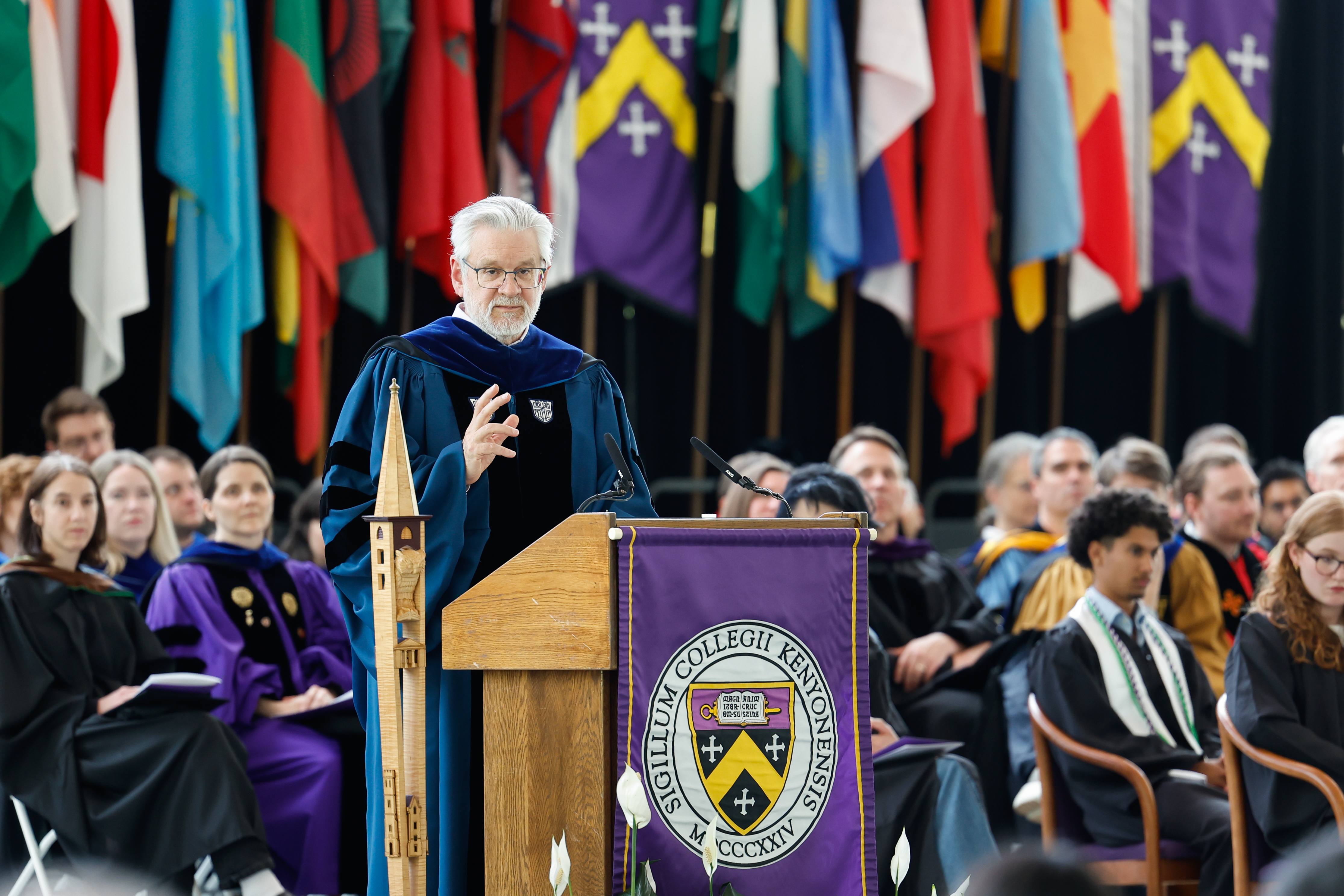
The following is the text of the address delivered by David M. Rowe, the Harry M. Clor Professor of Political Science, during Kenyon’s Baccalaureate ceremony on Friday, May 15, 2026. Rowe, who joined Kenyon in 2001, teaches political economy, comparative politics and international relations and was chosen to speak by the Class of 2026.
Good afternoon!
Congratulations, Class of 2026, and welcome to your parents, families and friends.
The tradition of the Baccalaureate address is over 500 years old. It started as a meditation on the world that graduates were about to enter, so that they might better navigate its many challenges.
It is in that spirit that I speak with you today.
Many of you have asked me — in class, in office hours, at faculty panels — how to be optimistic about the future. The myriad problems of today’s world appear so daunting that optimism itself seems to be drifting ever further out of reach.
Today I will share why I am an optimist.
But the pathway won’t be direct, and beware, my remarks will explore human violence and darker aspects of human nature.
I have dedicated my entire professional life to understanding how to achieve a world of peace. I have come to realize that the human capacity for violence — the intentional infliction of intense physical pain or death upon another — is, paradoxically, the cornerstone on which peace is built. If we want to build a world of peace and justice, and once made, keep it, we must be willing to inflict violence on others, for without violence, that world can neither be built nor sustained.
That’s a big claim. If this troubles you, it should.
The reasons have to do with the nature of violence itself.
First, violence is physically easy. All it takes is an open hand or a closed fist. It is within the physical abilities of nearly every person to be violent toward another.
Second, we are all capable of inflicting violence. Have you ever felt the urge to physically hurt somebody? Maybe it was an annoying co-worker who just won’t listen or someone who cut you off in line.
Or maybe the reasons were more serious. Perhaps that person deeply hurt you. Stole from you. Humiliated you. Vengeance is among our most powerful drives.
Third, we are all hard-wired to fear the intense pain and even death that violence at the hands of another entails.
Finally, violence — and each person’s natural fear of violence — are useful for shaping the behavior of others. If someone stronger than you threatened to beat you up unless you handed over your wallet, would you do it? And if they threatened to kill you or someone you love, is there anything you wouldn’t give up? And it’s here — the fact that violence is useful — that the relationship between violence and peace becomes so complex.
We often treat violence as backward-looking and reactive, the consequence of some prior injustice. To make peace, all we think we really need is a commitment to nonviolence and the moral courage to break the cycle of violence, to turn the other cheek, to end the injustice, to give peace a chance.
But what if the reasons and motives for violence lie not in the past, but in the future. What if we use violence not to right past wrongs, but prospectively, to get things we want from others that we do not yet possess? How do you bring that kind of violence — useful violence, predatory violence, visionary violence — under control? Education? Moral suasion? Ask yourself: Have you ever done something you knew was morally wrong, but did it anyway, because you benefitted?
I think we all know the answer.
If all this makes you uncomfortable, you might now be asking, what do I, David Rowe, really know about any of this? I’m just a professor in my ivory tower, playing academic parlor games about a world far beyond my own lived experience. If I truly knew that world, interrogated that world deeply, and saw the immense suffering that real violence imposes every day on real people, I would think and teach differently.
It’s a fair point.
My own direct experiences with violence are thankfully few. But I did grow up with the sense that real violence — world-destroying violence — was never truly absent. It lurked, even on the happiest days, like an ominous thunderstorm just over the horizon, signaling its presence at the very edge of perception, neither seen nor heard, but unmistakably there.
You see, my father, Charles Alvin Rowe of Sacramento, California, was an infantryman in the United States Army in World War II. He enlisted in 1942 at 20 years old. Like most of his generation, he did not speak about — much less revel in or “meme-ify” — the destruction, death and brutality of war. But the war was always present, my family’s private version of the background hum of cosmic radiation from the Big Bang long ago. With one notable exception, my father almost never, and I mean never, talked about this part of his life.
I once pressed my father about the war. I was just back from my junior year in Germany, had visited places he had fought, and wanted to know him better. We began with easy banter about army life, but our conversation withered as combat loomed. My father tensed. His eyes teared. His soul turned inward. “I can’t,” he whispered, turned his back, and walked away.
You see, my father fought in some of the most intense combat of the European theater — in Normandy and northern France, the Battle of the Bulge, across the breadth of Germany. He spent much of the war seeking out the enemy in a reconnaissance unit. In April 1945, his unit came across the Buchenwald concentration camp. His photographs bear stark and silent witness to the unfathomable cruelty of that place: the high barbed wire fences, the skeletal bodies of the newly liberated, the stacked bodies of the dead. By the war’s end, my father, then 23 years old, had seen some of the worst that humanity has to offer.
After the war, my father became a ranger with the National Park Service, fell in love with my mother, and together they raised four sons. Perhaps you are thinking that my father found in nature a respite from man’s violent inhumanity to man. But that is not so.
A National Park Ranger, you see, is a federal law enforcement officer in a surprisingly dangerous branch of law enforcement. One can be the only federal agent for miles in a place whose very remoteness attracts those seeking to evade the law. My father was once the arresting officer of a poaching ring. As the trial neared, the poachers’ cronies would telephone death threats to my mother, telling her that should he testify, she would find my father waiting at the courthouse, in pieces.
In a world where predatory violence is always tempting for some, where some will use violence and fear to get what they want from others, how do we protect ourselves from their predatory impulses? Bring them under control? What recourse, other than organizing an even greater capacity for violence, do we really have? And so we come to the paradox at the heart of all peaceful societies. One of the very things we most seek to avoid — violence and harm at the hand of another — is precisely the instrument by which a world of sustainable, prosperous, and just peace becomes possible.
We build this world in two interconnected steps that create that entity we call “government.” One step is to write “law,” the authoritative rules that govern our society, the most basic of which render the private use of violence illegal. The other is to make law effective by building a structure of law-enforcing violence — staffed by people like my father — sufficiently overwhelming to compel compliance when necessary.
As people come to follow the law and live within its protective shadow, something truly remarkable happens. Violence recedes from everyday life, not just the predatory, interpersonal violence that the law makes illegal, but even the protective, law-enforcing violence on which compliance rests. If the law is never broken, that violence need never be used. Fear gives way to trust, creating a peaceful world of human flourishing that seems so self-evidently good, so ordinary and natural, so much a part of our everyday lived experience, that we scarcely notice the violent foundations on which it rests.
“How’s the water?” says one fish to another. “What’s water?” comes the reply.
But nothing about this world is natural. Consider for a moment the United States Declaration of Independence. Some are skeptical of the Declaration because of the hypocrisy between the Signers’ claims of human equality and the many injustices of their society. But the Declaration is a deep and subtle document, for even morally flawed people (and who among us isn’t) can grasp universal truths.
The Declaration is most celebrated for its sweeping assertions of human equality and universal rights. “We hold these truths to be self-evident,” it proclaims, “that all men are created equal, that they are endowed by their Creator with certain unalienable Rights, that among these are Life, Liberty and the pursuit of Happiness.”
So far, this passage merely states a moral premise fit for a Kenyon seminar. What really matters comes next: “That to secure these rights,” the Declaration continues, “Governments are instituted among Men” and further “[t]hat whenever any Form of Government becomes destructive of these ends, it is the Right of the People to alter or to abolish it, and to institute new Government, [such] as to them shall seem most likely to effect their Safety and Happiness.”
Here the Declaration reveals its depth. It identifies the default state of human affairs as fear, insecurity, and injustice. We cannot enjoy our universal rights — the foundations of a just society — without first instituting government to keep us safe. But there is also great danger here, for the government’s overwhelming violence may be twisted to self-serving ends by those who write its laws and wield its sword.
How does this happen? The fault lies in our human nature. Each of us is a discrete and separate person, making each of us the center of our own world. We experience that world filtered through our own senses and appraise its moral contours relative to our own being. When we come to define what justice actually is — not as some abstract premise in a college seminar — but in the real flesh-and-blood world where laws backed by violence decide who gets what, whose interests and values get privileged and whose do not, we will naturally define justice in ways that cater to our own self-centeredness. Our natural inclination will not be to define justice broadly, to include people not like us, but to draw distinctions between us and them, to show why we are deserving and they are not.
But every distinction made to set ourselves apart will always be arbitrary and subject to further arbitrary revision. There is no natural resting point at which the process stops. How many generations of ancestors must you have in this country before you are a true and deserving American? None? One? Ten? Twenty? We can always draw the circle tighter so that the deserving — the “us” — become ever fewer, while those who are not — the “them” — grow ever larger.
The more narrowly we define how justice becomes expressed in concrete law, the more easily we advance our interests at their expense and justify imposing our will on them, not because doing so serves us (which it does), but because this state of affairs (so we say) is simply what justice requires. There is, in other words, a natural tendency in social and political life toward a world of tyranny in which might makes right.
How do we arrest the slide into the abyss?
The Declaration’s genius is to anchor justice in universal principles of human equality that exist prior to any group, society or government. Drawing the circle of deserving more tightly will always violate these principles, providing those excluded with a powerful moral and political basis from which to mount their complaint.
The arc of history may indeed be long and bend toward justice, but if so, it is not because justice is an immutable law of history — if anything the arc bends in the opposite direction — but because we have grounded our system of government in principles that produce this very dynamic.
Even so, flawed people cannot write perfect law. Every effort we make to translate universal principles of justice into real world law will always be unjust to some in some way. When the law reflects the perspectives of those not like us, it will fall short of what we think justice demands. When we write into law exactly what our vision of justice requires, others will feel an injustice imposed on them. Every attempt to institute justice will be imperfect and contingent, requiring constant good-faith renegotiation if we are to persist as a people.
These tensions are why dialogue and deliberation are so central to liberal democratic governance, but also why liberal democracy is so challenging to sustain. It requires not just voice and protest but good-faith listening and the willingness to accommodate. The problem is that those most harmed by our (self-centered) attempts to institute justice will be precisely those who fall farthest from the scope of our concern and understanding. This makes it all too easy to overlook their moral injury and use the power of law backed by violence to impose our vision of justice upon them.
And so begins anew the slide toward the abyss.
Little of what I’ve said so far seems to provide a basis for optimism. So, why am I an optimist?
Let me explain through a personal story of two Christmas Eves, the most hopeful night of the Christian calendar. Christmas Eve heralds the birth of Jesus the Messiah, God’s appearance in human form to walk among us and give hope.
On Christmas Eve, December 24, 2024, my wife and I, along with our two grown children, were in a small town in Germany to close up the household of my wife’s maternal aunt, Gertrud La Roche–Jeschke, who had recently died.
Like my father, Gertrud had been profoundly affected by the war, but as a child not yet 12 years old when the war ended. With her mother (my wife’s grandmother), she used to hide under the living room carpet late at night to listen to Allied radio broadcasts, hoping for news of the war and an end to the Nazi regime against which they, simply by listening to the radio, were committing treason. She had once been dug out of a collapsed building that took a direct hit from an Allied bomb; been strafed by an Allied fighter plane as she played outside; been an unwelcome refugee after the war, despised because she was just another mouth to feed.
As an adult, Gertrud became a physician and dedicated herself to the healing and care of others. She had no children of her own. We were her family, often spending summers and holidays at her house. We loved her deeply.
The midnight Christmas Eve service was enchanting and poignant. Our worship took place in a magnificent Baroque church, where marble angels flit and fly high above gleaming white walls, beckoning toward the frescoed ceilings that depict an open doorway joining heaven to the world below.
My children and I broke bread with fellow worshipers, sang hymns of joyful anticipation, prayed for God’s healing, especially for those caught by the cruel wars in Gaza, Israel and Ukraine. We ended our worship by extinguishing all light but that of a single candle, flickering against the heavy dark. As we sang the quiet and moving carol “Stille Nacht” — which you may know as “Silent Night” — the priest took that single candle and walked slowly through the congregation, stopping at each row of worshipers, so that the person at the end could light their own candle and, in turn, pass its flame to their neighbor. Darkness receded as each added candle cut deeper into the gloom, filling the void with a warm glow, while we sang of God’s pure love coming to us as the baby Jesus sleeping peacefully in his mother’s loving embrace.
It was well past midnight as my children and I walked out into the clear, frigid night to make our way home. The stars were so bright and seemed so near, one imagined it possible to simply pluck them from the sky. As we crested a snowy hill, I stopped my children to take in the night’s serene beauty and tell them of another Christmas Eve, exactly 80 years to the day prior to that moment.
My father spoke only once of his combat experiences. Shortly before his unexpected death, I visited my parents with my then girlfriend and now wife, Pamela Camerra, whom many of you know as Professor Camerra-Rowe, or more affectionately (but never to her face) as Pam Cam. My wife’s love and empathy unlocked my father’s anguish. At dinner that evening, completely unbidden, my father, for the first and only time, spoke about his combat experiences and of the dark melancholy that would often overwhelm him, especially around the Christmas holiday.
On Christmas Eve, December 24, 1944, my father’s unit had taken up positions outside a village in Luxembourg as part of the Battle of the Bulge. They were so near to the German lines, the night air so cold and still, that he could hear the soft notes of German soldiers singing “Stille Nacht” — “Silent Night” — as they sought comfort in God’s love for this world. Sometime later, but well before dawn, the scream of artillery barrages shattered the nighttime calm. The order came to attack the German positions. The firefight that followed killed my father’s best friend.
Perhaps his friend was Everett Coram of Shafter, California, or William Fleming of Providence, Rhode Island, or Leo Walsh of Chicago, Illinois, or perhaps someone else. My father never said. These were but three of at least 13 people in his regiment killed in combat that Christmas Eve and Christmas Day.
As my children and I, beneath that cold and brilliant sky, pondered the strange and recursive paths that guide our lives through time, we were acutely aware of the many deep and meaningful complexities of that moment. You see, my children’s other grandfather, my wife’s father, Ernst Camerra of Vienna, Austria, was a German soldier in the war. He was conscripted into the German army in 1940, just 17 years old, and sent to fight in Belgium. He, too, never spoke of the war, but his body, in testimony to its horrors, bore large and ugly scars of an explosion that sent shards of hot shrapnel clean through his torso. Had my wife’s father been one of the German soldiers that my father heard singing quietly on that terrible night, we — my daughter, my son, my wife and I — our family — could well have never been, for her father and my father were sworn enemies each with a duty to kill the other.
And it is, here, in this story of two Christmas Eves, that we begin to find reasons for why I am an optimist. I have painted for you a picture of a world in which vengeance is one of our most powerful drives, a world thoroughly suffused by the human capacity for violence, a world that that produces all manner of intentional human cruelty, a world where we build peace only through our own willingness to impose violence on others, a world in which any justice that we achieve will be imperfect and contingent, and a world where God, if there even is a God, can seem utterly unresponsive to our plight.
And yet.
And yet, despite all these things, that imperfect world can also be one where a young man falls deeply in love with the daughter of his father’s erstwhile enemy and she with him, a world where they together raise two wonderful children, a world where their family weaves bonds of love across a divide that caused the deaths of millions and the life-long anguish of many millions more, and a world that was rebuilt, in the wake of that conflict, however imperfectly and incompletely, not on vengeance, but on the radical premise that you and I are fundamentally equal and equally deserving of moral dignity.
The fact that such a surprising and unlikely world can emerge from the ashes of the world’s most destructive war is a reason for optimism. The many imperfections of human nature do not condemn us to a world of cruelty and injustice.
But it is also flashing warning light against complacency. To believe that good will prevail because it has in the past requires nothing of us but to wait for the dawn of a new and better world. But if that hope is the basis of our optimism, the new dawn will never break. For we also know that the default state of human affairs is fear, violence, and insecurity; that social and political life naturally tend toward tyranny and might makes right; and that should the arc of history bend toward justice, it does so only because we, through our own human agency and acting in self-awareness of our human nature, have bent it to that purpose.
Real optimism, meaningful optimism is not the naïve belief that good will prevail, but rather a moral commitment to keep open the possibilities for good to emerge. It is grounded in self-awareness of the faults in our human nature and guides us to act in ways that counter their pernicious effects. It especially seeks to work against our natural tendency to divide the world into “us” and “them,” by not only recognizing the fundamental humanity of all, but by holding all to the same moral standards. This counteracts our natural tendency to overlook the transgressions by those we call friends, thus making us complicit in their moral blindness. It also opens the possibility that those we call enemies may be deserving of our charity and grace, such as that which allowed my wife’s parents to emigrate to this country and become its citizens, even though her father had once borne arms against it.
Optimism as a moral commitment holds that each of us possesses moral agency and bears responsibility for our moral choices. Malice and evil, as my father witnessed, do exist, and there are transgressions beyond our human capacity to reconcile. We will often confront the need to judge others and hold them to account but must do so in awareness of our own imperfections, and take care to be even-handed, fair and judicious. Only then can doorways to a better world remain ajar.
Optimism as a moral commitment recognizes that the broader forces that shape the world are often beyond our direct control. Even so, we exercise substantial agency over how we interact with that world. Our moral choices will affect not just our day-to-day lives, but also the possibilities that the future may hold. Had my father chosen to harbor deep hatred against all Germans because “they” had killed his best friend, my own family, his own grandchildren, would likely have never been.
Optimism as a moral commitment is not just something we profess, it is how we act, not only in public, but especially in private. For it is behind closed doors that we reveal to ourselves what we truly value and who we really are. When my wife’s grandmother and aunt secretly listened to Allied radio (something they did not have to do), they were making a moral commitment to a world beyond the present, a commitment whose profound risks could not but inscribe itself deeply into their very souls.
Optimism as a moral commitment is not a how-to guide to personal success or social justice, but a bond we forge with those we love to hold open the possibilities that they may enjoy better worlds, even if we ourselves, as was true of my father’s best friend and the many, many like him, never see the break of the new dawn’s light.
Finally, optimism as a moral commitment calls on us to be open to all the possibilities we cannot yet see. It is a guiding star to navigate the turbulent currents of our lives, most important precisely when there is no path ahead, for that is when hope is most likely to curdle into apathy or despair. Trapped beneath a collapsed building, my wife’s aunt could not have possibly imagined the strange and wonderful world that awaited her, nor could my wife’s father nor my father on their darkest days see the worlds that awaited them, but how each of them chose to live their lives is what made those worlds possible.
In a letter to his parents on Mothers’ Day, 1945, my father announced the war’s end with the simple words, “Well, it’s over now.” The war with its many horrors was indeed over. But building a more just world still lay in the future. But the possibilities for that world were there, just as they are for you.
I wish you, Class of 2026, not just optimism for better worlds, but that you may carry your moral commitment to those possibilities throughout your lives, especially on your darkest days when there’s no clear way ahead, for only with that optimism, and how it guides you to act toward yourself and others, in public and in private, will the door to better worlds beyond this one remain open.
Is that enough for one day?