Every four years, it seems, the world rediscovers the joy of curling. For one Kenyon staff member, however, it’s become a passion that never passes.

Mandy Gadrow ‘97, lead systems analyst in the Advancement Division, finds herself competing in the winter sport up to three times a week, participating in two leagues in nearby Columbus and in weekend tournaments — bonspiels, for those in the know — across the country.
She is a former board chair of the nonprofit Columbus Curling Club, one of five clubs across Ohio and the closest to Gambier. Gadrow fell in love with the community of the sport and has been following it closely during this year’s Winter Olympics in Italy.
She discussed her journey with the sport — in which two teams take turns sliding 42-pound granite stones toward a target, sometimes sweeping the ice to extend the path of the stone or alter its trajectory — and why it’s so much more than bocce — or chess, or shuffleboard — on ice.
How did you get into curling?
I’ve been watching it forever. Then, in 2018, one of the teachers at my kids’ school put a “Learn to Curl” clinic voucher in a silent auction, and I said, “You can do that yourself?” I always assumed it was like gymnastics, and you had to start when you’re 4 years old. No, you can start at any age. And there’s a club in Columbus. So my husband was kind enough to stand next to that little piece of paper in the silent auction and outbid everybody as they came along.
What got you hooked?
What I love most is that it’s a combination of strategy and community. The strategy is the “chess on ice” thing. Every time a rock is thrown, you have to adjust your strategy to make sure that you’re still in a winning position. Whether you make the shot or miss the shot, it changes the landscape of the target. It changes what you should do next. And it’s a very welcoming, open, inclusive community. It’s one of the most sportsmanlike games you’ll ever see. You shake hands before and after the game. You compliment your opponent on a good shot. And at the end of the game, you put your brooms off to the side and sit around a table and share a chat and a drink together.
Who is the sport right for?
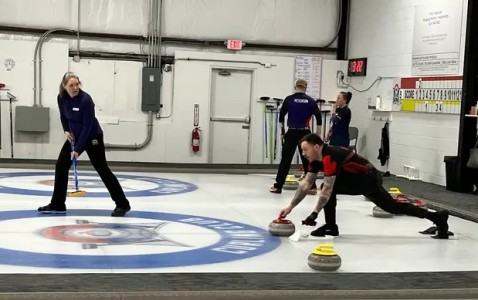
This sport is right for anybody, honestly, because you don’t have to be a super duper athlete to play well. We have a lot of accommodations for folks who aren’t as mobile as others. So you can squat down and deliver the rock the way you see on TV, but we also have special sticks where you can deliver from a walking position. And there are also options for wheelchair curlers as well.
How are you enjoying the Winter Olympics?
When it’s not an Olympic year, I still watch a lot of the Canadian and international events. You can find them on YouTube. So I actually know a lot of those international teams, and I’m sort of lowkey rooting for everybody. But obviously the U.S. just won the silver medal in mixed doubles, and I’m super stoked for them. There’s also the men’s and women’s team play (which continues through Feb. 22) and I’m following along with that, too, in all of my free time.
So the sport is called curling. How do the rocks curl?
Nobody knows exactly why the rock curls. They know that it does, but nobody knows exactly why. There’s no physicist who’s ever figured that out.
That sounds like a new summer research project for one of Kenyon’s physicists.
Yes. And good luck because they’ve been trying for decades. A curling stone has a little ring on the bottom, and so it’s only that ring of the stone that’s actually touching the ice. The ice isn’t smooth like it is for hockey; it’s got little bumps on it that we call pebbles. When those bumps catch the ring on the bottom of the rock, it will cause it to turn. The sweeping keeps it straighter and helps it go farther, so you can manipulate where that stone ends up with your sweepers, but there’s still debate about exactly how it curls the way it does.