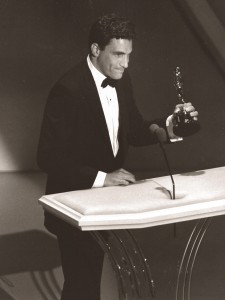
Film and television director/producer Adam Davidson ’86 understands the power of a good story — and he’s got plenty of them.
His career has included work on some of television’s most iconic series, including “Community,” “Grey’s Anatomy,” “Friday Night Lights,” “Deadwood,” “Fear the Walking Dead” and “Lost.” He’s a director on an upcoming Netflix limited series adaptation of Harlen Coben’s “I Will Find You,” starring Sam Worthington, and two feature films that he made under the banner “One Mile” starring Ryan Phillippe were released this past weekend.
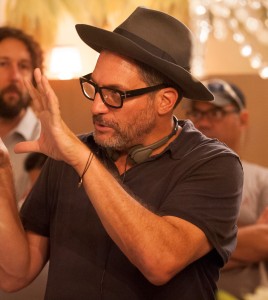
But it was his first film, “The Lunch Date” — made just a few years after graduating from Kenyon — that won him an Academy Award in 1991.
And yet, the story he might most enjoy telling has to do with his deep connection to everything Kenyon: professors, classmates and a new generation of aspiring student filmmakers.
The Los Angeles native knew he wanted to be involved with film ever since he was 12 but made what might have seemed like a surprising choice to leave Hollywood for rural Ohio. Here, he said, he became a history major who was encouraged by gifted faculty members to probe subjects deeply and ask challenging questions about anything that interested him — that turned out to be everything from the origins of the Southern dialect, to the persecution of the Jews during the Black Plague, to a 120-page honors thesis on racism in American popular culture at the turn of the 20th century.
He also found ample opportunity to explore other aspects of himself outside of the classroom by acting in plays, creating in the sculpture studio, forming a two-piece punk band, joining a fraternity, getting in a little trouble — “After all,” he said, “two of my Kenyon heroes, Paul Newman and Jonathan Winters, did!” — and especially playing on the football team, where he was a two-time All-American and former team captain who still holds the single-season sack record.
All of this was an important prelude to a career in film that started with “The Lunch Date,” a movie he made for under $4,000 while pursuing a master’s degree at Columbia University in New York. The black-and-white live action short, which won the Short Film Palme d’Or at the 1990 Cannes Film Festival, is about preconceived biases and assumptions. In 2013, it was added to the Library of Congress National Film Registry after being deemed “culturally, historically and aesthetically significant.”
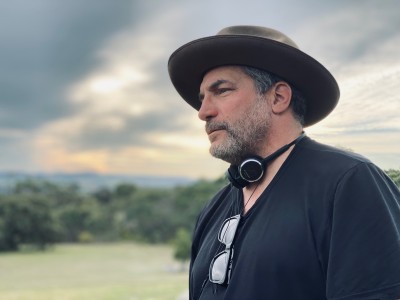
Along the way, Davidson has maintained a strong relationship with his alma mater, meeting occasionally with students of his classmates Jonathan Tazewell ’84, who now serves as Thomas S. Turgeon Professor of Drama and Film, and Professor of Film Jonathan Sherman, a classmate from Columbia. He also will be participating in Kenyon LA, a new two-week immersive academic study and hands-on career exploration in film, media, and related fields for students this summer.
And while his Oscar statue may be a little worse for wear — it suffered a hole in its forehead when it fell from his parents’ mantle during an earthquake years ago (“It adds character,” he said) — Davidson’s passion for good storytelling and the role that Kenyon plays in developing talented storytellers has never wavered. A voting member of the Academy of Motion Picture Arts and Sciences, Davidson took a few minutes prior to this year’s Academy Awards on March 15 to talk about his Kenyon journey and how it might inform future filmmakers.
This interview has been edited for length and clarity.
You’re an L.A. kid with two parents in the entertainment business. How did you end up at Kenyon?
The last thing you would think to do if you want to get into film is go to this small liberal arts college in the “middle of nowhere,” which at the time didn’t even have a film program. But it was intentional on my part. When I started thinking about college, I explored the idea of going to film school right away. It didn’t quite sit with me, and I talked to somebody who said, “You should think about getting a liberal arts education first.” That stuck because I thought one can always learn the technical side, and, in fact, the technology is always changing. But the films I loved were all about something, and the filmmakers who told them — the storytellers — were all interesting people with something interesting to say.
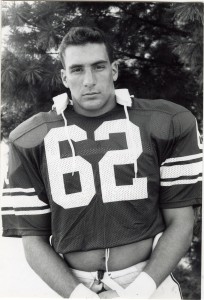
So how do you become “interesting”? At Kenyon, I could build a foundation. I could take philosophy classes in aesthetics. Study art history. Study Shakespeare. Study poetry. I could take a foreign language and, what’s more, I could study the “study of language” itself — anthropological linguistics — and how societies form languages and how that may inform the way they think and tell their stories. “Film is a language,” I thought, “so let me take that.” I felt like I needed to get a broad education, and so a liberal arts college appealed to me. Plus, not being the biggest or the fastest, I could still play Division III football. Every day on a film set is teamwork. And every day, putting on the helmet, I was “acting.”
What is your message for current Kenyon students that you meet?
I never like to give advice because I don’t want to be held accountable. (Laughs.) But please know: There is no one route. Everybody’s on a different path, and you can’t look to your left or your right. You’ve got to just keep looking straight ahead and don’t compare yourself. You’ve got to find a way to make something — don’t worry about the budget; work to your strengths.
What can they learn from your experience with “The Lunch Date”?
First and foremost, they should say to themselves, “Well, if he can do that, I can too.” I also want them to know that it was rejected from every festival that I applied to — like, the first six or seven festivals in a row! I was pretty convinced I had made a bad movie. I can’t really explain what happened next. I didn’t change one thing. Not a frame or a sound. But suddenly it was like the wind shifted, and it started getting into more and more festivals and winning awards. To be clear: I wasn’t trying to win awards. That was one of the last things on my mind. I was just trying to teach myself how to tell a story — visually. (Initially it was conceived as a silent film.) Lastly, I would tell students you want to make something that’s true to yourself and unique. I still believe that an original story can stand out and that audiences want and are hungry for that as well.
What can students take away from Gambier that they won’t necessarily get from a place like Hollywood or New York?
They can become critical thinkers — people who can dive into a subject, think deeply about it, articulate and write about it, and explore something that interests them without worrying at the moment for how it’s going to lead to the next thing. Incubate. Think Kenyon values: the value in exploration for exploration’s sake and the belief that the growth that comes from it will enrich your life and you as a person. And that the beauty of Middle Path on a fall day — and your classmates from a different side of the country — are also a part of that.
Are you excited for the Kenyon LA program bringing students out this summer?
I think it’s a great idea. Students might learn that there are lots of different jobs and fields out there that make up the industry. And it’s always good to hear from people who have gone through it and lived through practical experiences, even though their path is going to be different than somebody else’s. Likewise, it’ll be interesting to hear from various grads what their paths were and what led them to where they are now. What did they study at Kenyon? And how has that informed them? Next month, I’m planning to go to a couple different (preparatory) events. It would be great if I was shooting something — I’d have students come, but I never know where I am. Plans change all the time. I’m used to it.
Is there one memory from Oscar night when you won that really stands out for you?
To be honest, it was overwhelming — like an out-of-body experience. This was my first film. Made for pennies. Nothing was making sense. So, jaded me had presumed the show must be rigged and they knew who the winners were going to be beforehand and sat them along the aisles so they could step out easily. But then suddenly they called my name, and you’re walking up, praying not to trip on the stairs. They hand you a trophy that’s heavier than you expect and wheel a giant monitor in front of you that’s counting down seconds from 30 … 29 … 28 …. You say what you can and then they hustle you backstage, and you go through a kind of automated carwash/gauntlet of print interviews, radio interviews, still photographers and television questions. And then, just as quickly, they spit you back out into the auditorium. And there I’m walking with my Oscar in my hand, and suddenly (Martin) Scorsese walks by. At that point, he hadn’t won one yet. My being frozen starstruck was the only thing that prevented me from handing the award over to him and saying, “Here, take this. You’re the one who deserves it.”
Read more about Kenyon Oscar winners.