Kenyon honored — and took a deeper look at — the legacy of Martin Luther King Jr. during its annual Day of Dialogue event in Rosse Hall on Monday.
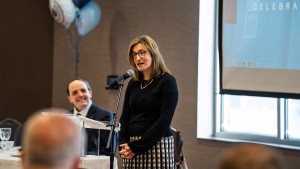
In her opening remarks, President Julie Kornfeld talked about the importance of carrying on King’s vision — challenging the status quo, provoking moral reflection and social action, and illuminating the path toward justice and equality — and the role the College can play.
“These three actions — challenging, provoking, illuminating — are essential to changemaking. I believe they are at the heart of everything we do at Kenyon,” she said. “To challenge, to provoke, to illuminate — that is the liberal arts at their best.”
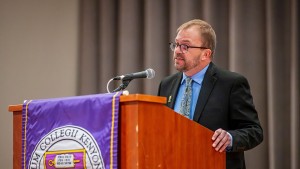
The event’s featured speaker was Patrick Jones ’93, an associate professor of history and ethnic studies at the University of Nebraska. He spoke on the theme, “MLK, Fugitivity and Creative Resistance in Troubled Times.”
Jones pointed to the crises of today as “a moment of deep political, economic, social and existential strain” that illustrate how much of King’s work is unfinished. And, drawing on the concept of fugitivity — a concept in Black studies describing active resistance, imagination, and escape from oppression — he discussed the many ways in which King was much more than his legacy as a dreamer and voice of harmony.
Indeed, Jones said, King was also an “architect of disruption” and “builder of crisis” as he considered “a great revolution and fundamental transformation of values in America and beyond.”
“As long as inequality is normalized, as long as policing substitutes for justice, as long as war is moralized, as long as poverty is managed rather than abolished, as long as human dignity and fundamental rights are not shared by all, King’s work remains unfinished and therefore demanding and thus dangerous,” Jones said. “And therein lies the ongoing challenge if we are willing to accept it.”
The annual Day of Dialogue program was organized by the Office of Diversity, Equity and Inclusion and the Office of Campus Events.
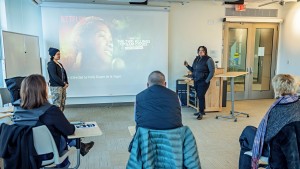
The event included performances by the Chamber Singers and POCapella, an a cappella group by and for people of color. Afterwards, there were three moderated breakout sessions in Chalmers Library.
John Rufo, assistant professor of American studies, and Naa Adjeley Anang-la ’26 hosted a discussion on “What Would Dr. Martin Luther King Jr. Say to Us Today?” A.F. Oehmke, assistant professor of art, and Sidney Plummer ’26 led a session on creative cultural resistance. And Orchid Tierney, the William P. Rice Associate Professor of Literature, and Charlie Brandt ’26 and Hannah Ehrlich ’26 facilitated a session on creative resistance.
Earlier in the day, Kornfeld joined with other educational and civic leaders in the community for Knox County’s Martin Luther King Jr. Commemorative Breakfast at Mount Vernon Nazarene University, which cosponsors the event with Kenyon every year. Its theme, “The Audacity to Believe,” came from the words of King’s 1964 Nobel Peace Prize acceptance speech. The keynote speaker was Ronald C. Todd, chief of social impact and opportunity at the Ohio Department of Development.
A number of service projects were scheduled in honor of Martin Luther King Jr. Day as well, organized by the Generosity Project. Students will assemble kits for the Village Network and students at Columbia Elementary School in Mount Vernon this week and sing for residents at area senior living communities in the coming days.