
William “Bill” Ezra McCulloh H’99
William “Bill” Ezra McCulloh H’99, a professor emeritus of classics who spent decades teaching ancient languages and literature to Kenyon students, died Dec. 5 at the age of 94. The Gambier resident retired in 1999 after teaching for nearly 40 years.
A Rhodes Scholar, McCulloh was known for his incredible intellect and could understand a vast array of languages, including Greek, Latin, Sanskrit, German, French, Italian and Russian. He influenced generations of students, both through his knowledge and his kindness and generosity.
“He was the most brilliant person I have ever known, bar none — and he was so humble about it,” said Professor of English Sarah Heidt ’97, who was his student and friend. “He had such a voracious, unstoppable curiosity about the world and about people.”
Born on Sept. 8, 1931 in Kansas to Ruth Stoner McCulloh and S. Ezra McCulloh, he grew up near Columbus in Worthington, Ohio. McCulloh graduated from Ohio Wesleyan University with a Bachelor of Arts and a triple major in music theory and piano; German; and English. Having won a Rhodes Scholarship, he continued his studies at Oxford University, where he earned a second degree in Literae Humaniores (classics).
McCulloh and his wife, Pat — an accomplished artist and educator who taught art at the College and died in 2024 at the age of 92 — arrived in Gambier in 1961 when he joined the classics faculty as an instructor. He was named an assistant professor the following year, upon the completion of his doctorate in classics from Yale University, and he went on to be recognized as one of the College’s most valued faculty members.
McCulloh became a tenured professor in 1968 and retired from Kenyon as the John B. McCoy-Bank One Distinguished Teaching Professor of Classics in 1999. At that year’s Commencement, he received an honorary doctorate that came with a citation — written and read by his longtime colleague and friend Robert E. Bennett, now professor emeritus of classics — that said his “career has launched a thousand dreams of inspiration and courage.”
Professor of Classics Adam Serfass credited McCulloh with designing the department’s elementary Greek course: “It’s this intense, community-building model where the students and instructor are in it together,” he said.
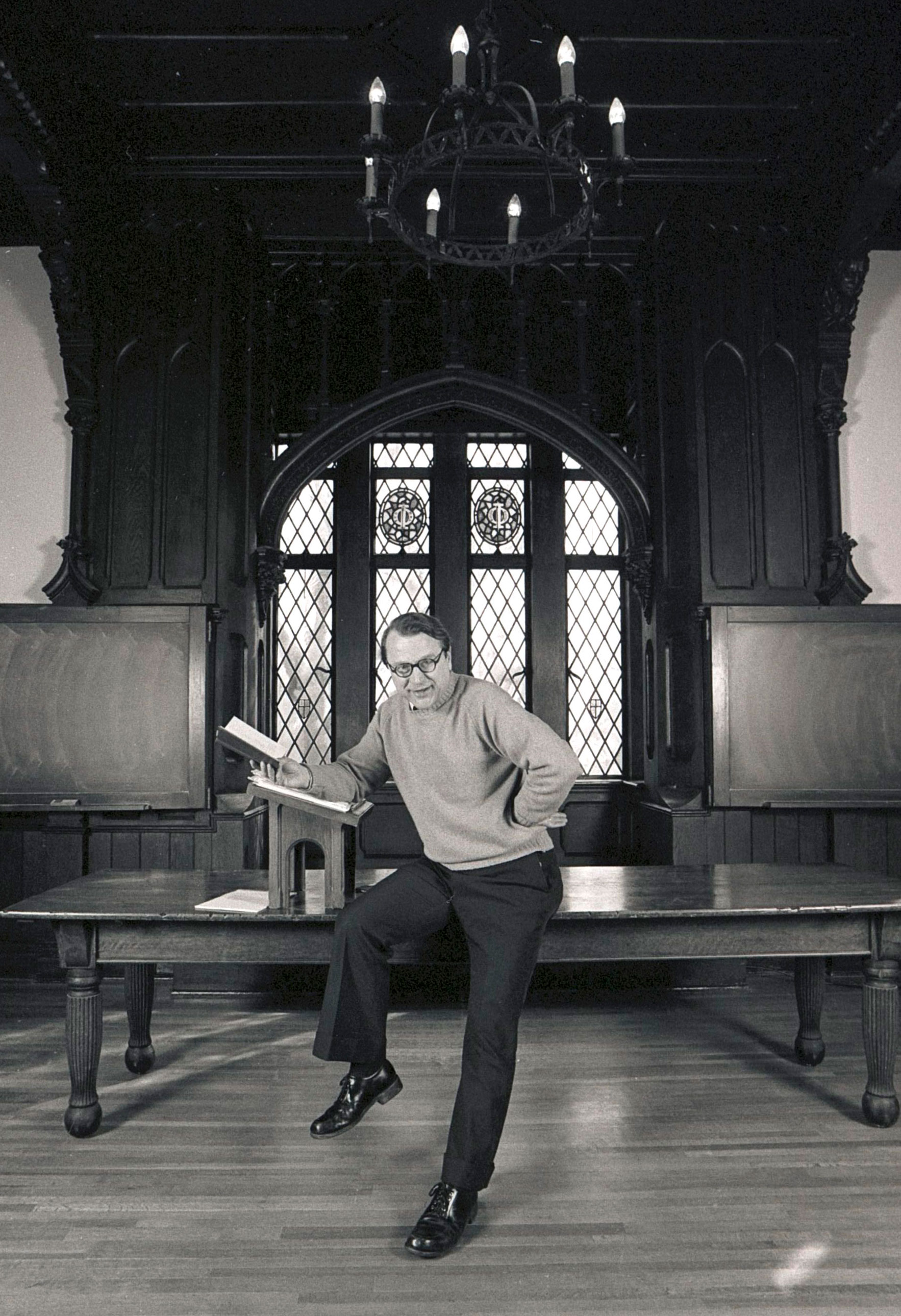
Stories about McCulloh’s ability to learn languages were legendary: that he taught himself Russian so he could read Dostoevsky in his native tongue, that he bought a copy of “Njal’s Saga” during a visit to Iceland so that so that he could teach himself Icelandic, that he learned Sanskrit over a summer — then proceeded to teach it the following semester.
Professor of Classics Carolin Hahnemann estimated that he could read poetry and literature in at least a dozen languages, and described the experience of getting to know him as “life-changing.”
Not only was he an esteemed scholar and voracious learner, they said, but he was modest, gentle and kind.
“He was genuinely interested in everybody,” Hahnemann said. “He really meant the world to so many people.”
Heidt, who had McCulloh as a faculty advisor and decided to add classics as a major after taking a course with him, had a similar experience.
“I really majored in Bill McCulloh,” she said. “He brought generosity and kindness and steadiness and stability and deep integrity into every single interaction, no matter how small it was. Everything mattered and every person mattered.”
McCulloh was named Ohio Professor of the Year in 1995, and the many awards he received during a distinguished career included the College’s Trustee Award for Distinguished Teaching. He delivered a Baccalaureate Address at Kenyon twice — first in 1970, when he became the first faculty member to do so, and again in 1995.
In his small, book-filled office, McCulloh was always happy to welcome visitors with hospitality and a cup of tea. That space served as a perfect reflection of his love for both Greek language and culture and his students, Serfass said.
In addition to two Greek manual typewriters, a jar of pinecones from the island of Lesbos, and dozens of empty boxes of Greek candy, it contained files on honors students who worked with him over the years — including blue books from students and future colleagues Perry Lentz ’64 H’09 P’88 GP’20 and P.F. Kluge ’64 H’20,
He followed his students’ accomplishments with pride, and particularly treasured the fact that former student Jeff Henderson ’68 H’94 dedicated his translation for the Loeb Classical Library of the ancient Greek author Longus — about whom McCulloh wrote his first book — to him.
Among McCulloh’s other scholarly interests was the 5th century author Pseudo-Dionysius the Areopagite, which occupied him on and off for decades and resulted in a manuscript that was self-published by his family in 2023.
McCulloh was a talented musician as well. He played piano and was an accomplished violist who took up the violin to be part of the string quartet led by his close friend, the late Franklin Miller, a longtime member of the faculty.
Professor of Music Benjamin Locke said McCulloh was a founding member of the Knox County Symphony who taught him about making sure others never felt intimidated and allowing students to demonstrate their best selves.
“We are all beneficiaries of his legacy,” he said.
McCulloh is survived by his children, Ann McCulloh and Michael McCulloh, and a niece. A memorial service at the Church of the Holy Spirit — where McCulloh had been an active member who sang in the choir — took place Saturday, Feb. 21, at 1 p.m.
View the Memorial Minute presentation by Professor of Classics Carolin Hahnemann and Professor of English Sarah Heidt ’97 honoring McCulloh at the February Kenyon faculty meeting.
Read the tribute “A Part of All That He Met” presented by Professor of English Sarah Heidt ’97 at the memorial service for McCulloh.