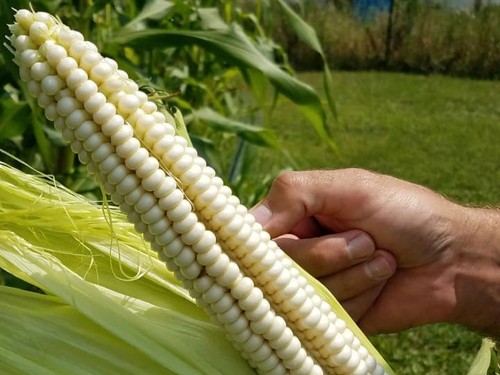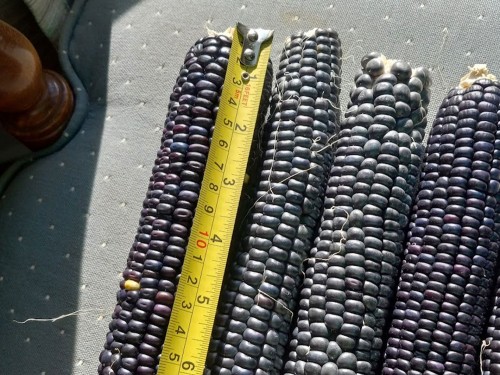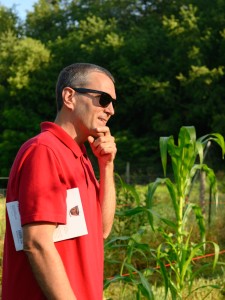
Bottiger has devoted his professional career to studying Native American agriculture, specifically corn, beans and squash.
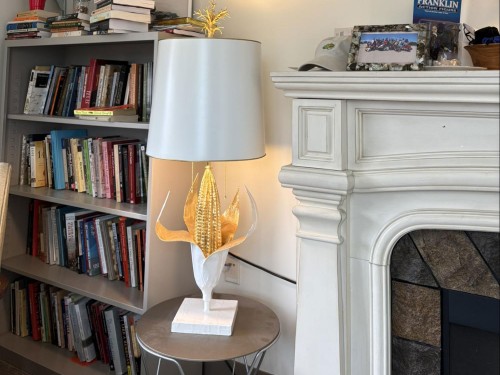
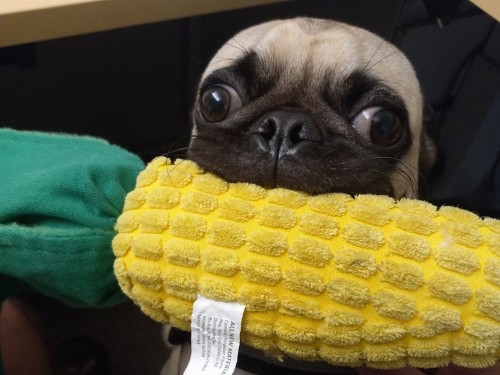
Patrick Bottiger, associate professor of history and the Kenyon Office for Community Partnerships’ Rural Life Faculty Fellow, has never liked eating corn. You might not guess that from his office which, in addition to being filled with books, features a lamp with a golden ear of corn for a base and a corn-shaped chew toy for his dog, Albert.
Bottiger has devoted his professional career to studying Native American agriculture, specifically corn, beans and squash — a group known in many Indigenous communities as the Three Sisters. Between the fields of corn he tends in his backyard and at the Kenyon Farm, the 300-level course affectionately nicknamed the “Corn Seminar” that he teaches every other year, and the book he is writing on the history of the Three Sisters, the edible grass has become much of his public personality.
Hence, the corny gifts that fill his office — an abundant crop for a guy who thinks corn tastes “disgusting.” Bottiger’s dedication to using corn to connect with the wider Knox County community, though, is no joke. He’s been busy with numerous educational projects related to corn in particular and the Three Sisters more generally.
Starting this summer, Bottiger will create a Three Sisters plot at the new Field of Discovery in Ariel-Foundation Park in Mount Vernon. Working with Tucker White — a junior at Kenyon and Summer Science Scholar — he will plant and tend corn, beans, squash and sunflowers, and put up signage with information about historical Indigenous planting methods to educate the community. Bottiger and White will host a workshop at the garden each weekend during the summer, and at the end of the harvest they will host an unveiling to reveal what rainbow gems lie under the corn husks.
Bottiger said he hopes some local farmers will bring their own corn and share their knowledge and family history, making the garden into a place for community conversation and bridge building.
These workshops could spark the first steps in a project Bottiger has imagined for a while: a Knox County seed library to keep the culture of the community alive, contained in humble seeds of corn.
Seed saving is something Bottiger has been passionate about for a while. It started seven years ago, when he began growing corn, beans, squash and sunflowers — not for food, but to preserve their seeds.
Working with an Indigenous seed bank in the Southwestern United States, Bottiger receives seeds of endangered heirloom varieties of corn, beans and squash. Some of the corn originated thousands of years ago. Some is 15 feet tall. And it comes in all the colors of the rainbow. Bottiger grows these seeds during the summer, carefully keeping them from cross-pollinating to preserve their integrity. Then he dries them for months before finally mailing them back to the bank in January.
“I’m not a plant biologist. I’m not even a history of science guy … so I had a lot to learn,” said Bottiger, who has a doctorate in American history from the University of Oklahoma, where he specialized in Indigenous history.
He shared his accumulated knowledge with the public during a seed-saving workshop that he hosted in October at the Brown Family Environmental Center. His practical tips included everything from how to keep the corn safe from hungry raccoons to how to prevent seeds from molding as they dry.
Organized by the Office for Community Partnerships, BFEC Director Noelle Jordan, and Sabrina Schirtzinger, an educator with the Knox County Ohio State University extension office, the workshop drew a completely full crowd of community members, students and Kenyon faculty.
Using corn, tomato and squash, Bottiger demonstrated techniques for how to get the kernels off the corn without damaging them, how to tell which seeds are viable, and how to prepare the seeds either for imminent germination or longer-term storage.
Bottiger plans to hold a similar workshop this coming fall and said he hopes to empower both hobby gardeners and farmers alike to engage in seed saving. Once common practice, seed saving has been largely abandoned, he said, leaving modern farmers reliant on buying from large agriculture companies and resulting in only a fraction of the genetic diversity that once existed.
As farms are sold and barns torn down, the remaining seeds — some of which have been in families for generations — are often thrown away, and that comes with big ramifications, Bottiger said. “When you lose a seed, you’re not just losing the seed,” he said. “You’re losing all the knowledge and all the decisions behind that seed.”
Bottiger says the role of the Rural Life Faculty Fellow is to connect Kenyon to the Knox County community, and he has found that farming is a wonderful way to do that. As he likes to say, “Corn is the language that this part of the country speaks.”