Assistant Professor of Physics and Astronomy at Michigan State University Adina Feinstein will visit campus to discuss her work studying young planetary systems.
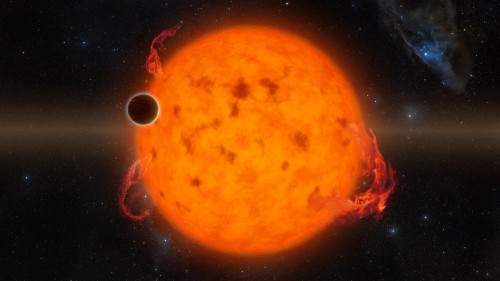
Within the past decade, we have discovered only a dozen young (< 300 Myr) short-period exoplanets, compared to the ~6,000 mature systems. The radii of these young planets are larger than older planets on similar orbital periods. The leading hypothesis is that these young planets have inflated atmospheres because they are still contracting. Inflated atmospheres are more susceptible to photoevaporation — atmospheric removal driven by X-ray and ultraviolet (XUV) stellar irradiation. These effects are intensified in the earliest stages of planetary evolution, when young stars are more active and produce extreme XUV radiation on a variety of timescales. Even though it is challenging to study exoplanets around active stars, observational constraints of these targets provide crucial insights into our understanding of exoplanet formation and evolution. In this talk, I will present several benchmark studies of young stars and their planets spanning from the ultraviolet to the infrared. I will present early results of the characterization of seven young short-period exoplanets from the JWST KRONOS program (GO 5959) and highlight our search for ongoing atmospheric escape. Additionally, I will present what we have been able to learn about the young host stars with these new high-precision observations. Understanding these properties is essential not only for correcting transmission spectra but for defining the environments that shape the fate of young planetary systems.
Join us on Friday, Feb. 20, for this exciting presentation from Feinstein. Lunch will be available in Hayes 216 from 11:45 a.m. to 12:15 p.m., and the presentation will begin in Hayes 211/213 at 12:10 p.m. We hope to see you there!