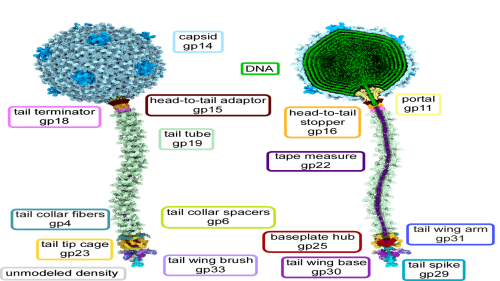
The most abundant biological entities on Earth are bacteriophages, viruses that infect bacteria. Around the world, these natural predators are being deployed alongside antibiotics to fight dangerous drug-resistant superbugs. From a physics perspective, phages can be viewed as biological nanoparticles with conserved structural elements: generally, a genome that is packaged into a protein shell called a capsid, which connects to tail machinery via a molecular motor known as the portal. These structural elements determine important factors like phage stability, bacterial host-range, particle immunogenicity, and more. Since bacteriophages are increasingly used as antimicrobial therapies, it is more important than ever to understand these structural determinants of phage function.
In this talk, Krista Freeman, assistant professor of physics at Case Western Reserve University, will guide you through several atomic-resolution bacteriophage structures that she solved experimentally with cryo-electron microscopy (cryo-EM). By presenting these structures alongside microbiological and immunological data, she will illustrate the power of “seeing” the phages in full detail. Insights from these data can drive engineering efforts to improve bacteriophages as therapeutics.
Join us on Friday, Jan. 30, for this exciting presentation. Lunch will be available in Hayes 216 from 11:45 a.m. to 12:15 p.m., and the presentation will begin in Hayes 211/213 at 12:10 p.m. We hope to see you there!