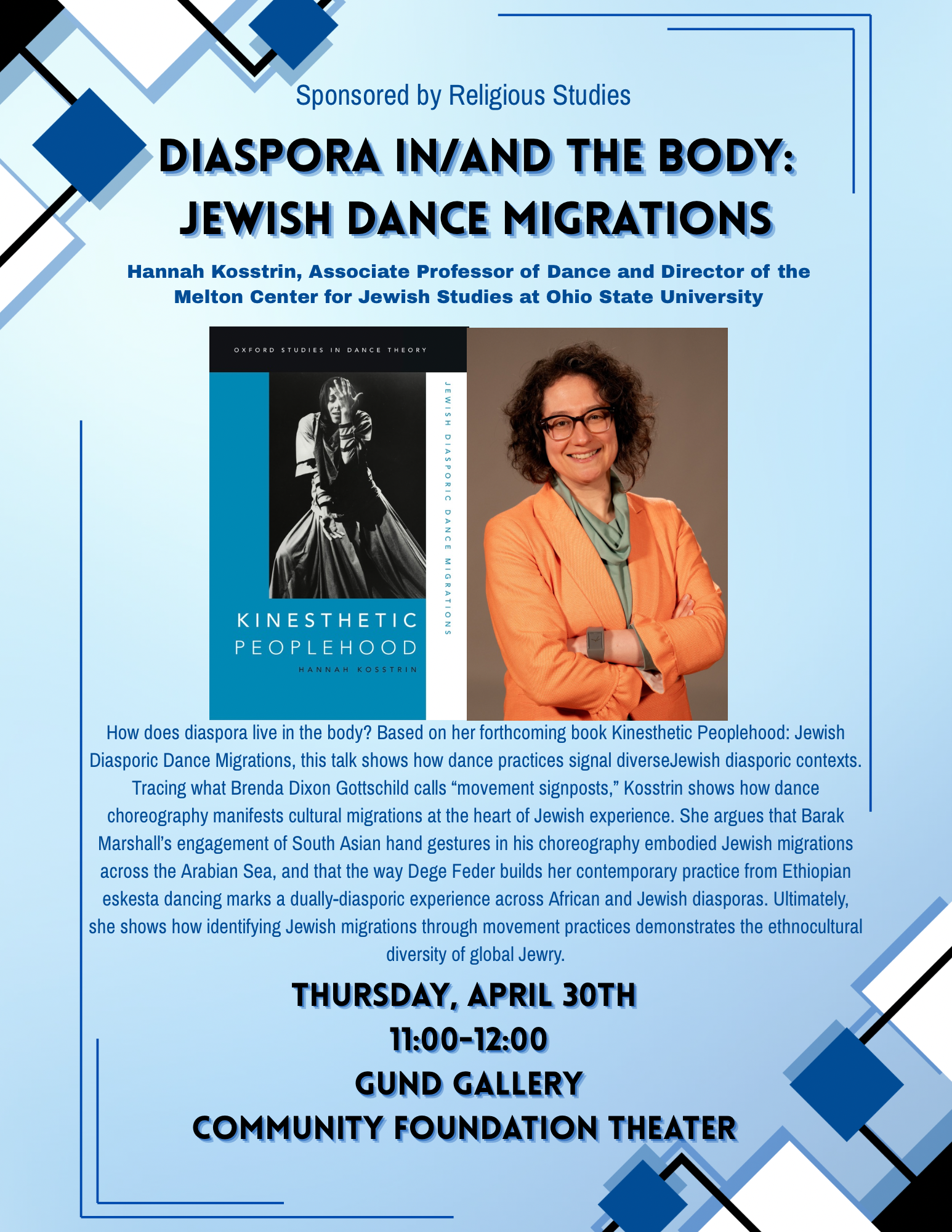
The Department of Religious Studies welcomes Hannah Kosstrin, associate professor of dance and director of the Melton Center for Jewish Studies at The Ohio State University.
How does diaspora live in the body? Based on my forthcoming book “Kinesthetic Peoplehood: Jewish Diasporic Dance Migrations,” this talk shows how dance practices signal diverse Jewish diasporic contexts. Like flavor notes in food, wherein ingredients reference foodways’ regions and histories, movements indicate time, place and syncretism. Tracing what Brenda Dixon Gottschild calls “movement signposts,” I show how dance choreography manifests cultural migrations at the heart of Jewish experience. I argue that Barak Marshall’s engagement of South Asian hand gestures in his choreography embodied Jewish migrations across the Arabian Sea, and that the way Dege Feder builds her contemporary practice from Ethiopian eskesta dancing marks a dually-diasporic experience across African and Jewish diasporas. Ultimately, I show
how identifying Jewish migrations through movement practices demonstrates the ethnocultural diversity of global Jewry.
Hannah Kosstrin is a dance historian and movement analyst who researches Jewish dance in global contexts. At The Ohio State University, she is an associate professor of dance and the director of the Melton Center for Jewish Studies. Kosstrin is author of “Honest Bodies: Revolutionary Modernism in the Dances of Anna Sokolow” (Oxford University Press, 2017), “Kinesthetic Peoplehood: Jewish Diasporic Dance Migrations” (Oxford University Press, 2026), and numerous articles. She serves on the editorial boards of the Journal of Jewish Identities, Dance Research Journal, and Shalvi/Hyman Encyclopedia of Jewish Women.