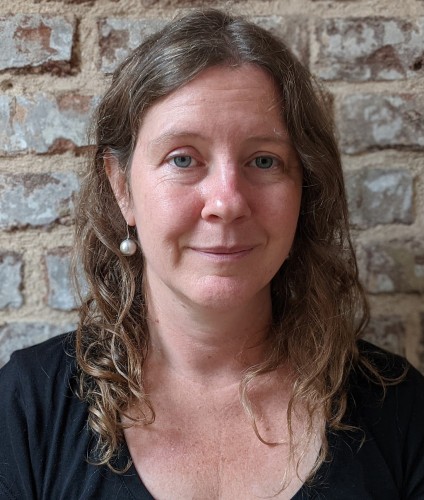
Rosemary O’Neill’s teaching and research interests include literature from the Middle English period (c.1100-1500); religion and popular culture in medieval England; and gender and sexuality in literature of all periods. She teaches classes on Chaucer, medieval romance and the history of marriage in literature, among other topics.
In 2022, she published a collection of essays, "Beer and Brewing in Medieval Culture and Contemporary Medievalism" (co-edited with Noelle Phillips and John Geck). She has also published scholarly essays on topics including: how "The Wife of Bath’s Tale" uses the medieval marriage ceremony to explore the relationship between choice and agency; why alewives appear in medieval wall paintings but not on craft beer labels; why medieval lyric poems decry Judas for being a terrible accountant; and how the medieval dream vision poem "Piers Plowman" can be understood through accounting tricks used to hide stolen sheep on the medieval manor. Her current book project, on how medieval writers understood the Christian afterlife as an extension of the earthly economy, allows her to make the case that the most popular surviving poem from medieval England, "The Prick of Conscience," is not as boring as everyone thinks it is.
At Kenyon, she has directed the Kenyon-Exeter program three times, served on the Tenure and Promotion Committee, and chaired the Department of Gender & Sexuality Studies.
Her research has been supported by grants and awards from the Medieval Academy, the Huntington Library and the British Academy.
Areas of Expertise
Medieval literature, history of the book, Chaucer
Education
2009 — Doctor of Philosophy from University of Pennsylvania
2000 — Bachelor of Arts from Univ Chicago
Courses Recently Taught
Each section of these first-year seminars approaches the study of literature through the exploration of a single theme in texts drawn from a variety of literary genres (such as tragedy, comedy, lyric poetry, epic, novel, short story, film and autobiography) and historical periods. Classes are small, offering intensive discussion and close attention to each student's writing. Students in each section are asked to work intensively on composition as part of a rigorous introduction to reading, thinking, speaking and writing about literary texts. During the semester, instructors assign frequent essays and may also require oral presentations, quizzes, examinations and research projects. This course is not open to juniors and seniors without permission of the department chair. Offered every year.
Each section of these first-year seminars approaches the study of literature through the exploration of a single theme in texts drawn from a variety of literary genres (such as tragedy, comedy, lyric poetry, epic, novel, short story, film and autobiography) and historical periods. Classes are small, offering intensive discussion and close attention to each student's writing. Students in each section are asked to work intensively on composition as part of a rigorous introduction to reading, thinking, speaking and writing about literary texts. During the semester, instructors will frequent essays and may also require oral presentations, quizzes, examinations and research projects. This course is not open to juniors and seniors without permission of the department chair. Offered every year.
From the invention of Valentine's Day to the notion of love as a sickness and to the articulation of courtship as a game with specific rules, many of our ideas about and expectations for romantic love come to us from medieval literature. Yet in the popular medieval genre of adventure story known as "romance," things do not always go according to love's rules: Men fall in love with other men, women resist getting married, and married women seduce their unsuspecting houseguests. In this course, we explore the complex messages about love and sex encoded in medieval romances. Our readings include poetry by Geoffrey Chaucer, the anonymous romances "Roman de Silence" and "Amis and Amiloun," Guillaume de Lorris and Jean de Meun's "Romance of the Rose," and the rules of love offered by both Ovid and Capellanus, as well as other medieval texts and contemporary works of theory and criticism. This counts toward the methods requirement for the major. Prerequisite: ENGL 103 or 104. Open only to first-year and sophomore students.
With a focus on major works — "Troilus and Criseyde," "The House of Fame," "The Legend of Good Women" and "The Canterbury Tales" — we consider Chaucer in the context of medieval literature and as a writer who anticipates modern questions of gender and authority. Reading in Middle English and exploring the social and historical contexts of Chaucer's fictions, we pay special attention to his preoccupations with the experience of reading, the revisioning of romance, the metamorphosis and translation of texts, and the status of the book itself. This counts toward the pre-1700 requirement for the major. Prerequisite: ENGL 210-291 or junior standing.
Individual study in English is a privilege reserved for senior majors who want to pursue a course of reading or complete a writing project on a topic not regularly offered in the curriculum. Because individual study is one option in a rich and varied English curriculum, it is intended to supplement, not take the place of, coursework, and it cannot normally be used to fulfill requirements for the major. An IS earns the student 0.5 units of credit, although in special cases it may be designed to earn 0.25 units. To qualify to enroll in an individual study, a student must identify a member of the English department willing to direct the project. In consultation with that faculty member, the student must write a one- to two-page proposal that the department chair must approve before the IS can go forward. The chair’s approval is required to ensure that no single faculty member becomes overburdened by directing too many IS courses. In the proposal, the student should provide a preliminary bibliography (and/or set of specific problems, goals and tasks) for the course, outline a specific schedule of reading and/or writing assignments, and describe in some detail the methods of assessment (e.g., a short story to be submitted for evaluation biweekly; a 30-page research paper submitted at course’s end, with rough drafts due at given intervals). Students should also briefly describe any prior coursework that particularly qualifies them for their proposed individual studies. The department expects IS students to meet regularly with their instructors for at least one hour per week, or the equivalent, at the discretion of the instructor. The amount of work submitted for a grade in an IS should approximate at least that required, on average, in 400-level English courses. In the case of group individual studies, a single proposal may be submitted, assuming that all group members follow the same protocols. Because students must enroll for individual studies by the seventh class day of each semester, they should begin discussion of their proposed individual study well in advance, preferably the semester before, so that there is time to devise the proposal and seek departmental approval.
In this course, we read both historical and contemporary feminist theory with the goal of understanding the multiplicity of feminist approaches to women’s experiences, the representation of women and women’s relative positions in societies. Theoretical positions represented include liberal, cultural, psychoanalytic, socialist and poststructuralist feminism. We explore the relationship of these theories to issues of race, class, sexual preference and ethnicity through an examination of the theoretical writings of women of color and non-Western women. This counts toward the concentration and the mid-level requirement for the major. This course paired with any other 0.5 unit/4 semester hour GSS course counts toward the social science diversification requirement. Prerequisite: any WGS/GSS course, approved departmental course. Offered every other year.
The major who wishes to participate in the Honors Program must have an overall GPA of 3.33 and a GPA of 3.5 in the major. The candidate in honors completes all requirements for the major, the Senior Capstone and two semesters of independent study and designs and completes a research project. This project should integrate feminist theory and methodologies as well as the student’s chosen disciplinary or interdisciplinary cluster. Each honors student prepares an annotated bibliography on the chosen project midway through the fall semester. After approval, the senior honors project is undertaken in consultation with a project advisor. Students are encouraged to think boldly and innovatively about the kinds of projects they undertake and about how those projects interact with and benefit their communities. Senior honors projects might include gender-focused sociological or historical studies undertaken locally; exhibitions, productions or installations of gender-exploratory art, music or theater; or political, social and/or environmental service-oriented or activist work. Students are closely mentored throughout their projects and, in the spring, are evaluated by an external evaluator and faculty in the program and in relevant disciplines. The evaluators assess the strength of the students’ overall work, as well as the strength of their self-designed, project-appropriate public presentations of that work. Permission of instructor and department chair required.
The major who wishes to participate in the Honors Program must have an overall GPA of 3.33 and a GPA of 3.5 in the major. The candidate in honors completes all requirements for the major, the Senior Capstone and two semesters of independent study and designs and completes a research project. This project should integrate feminist theory and methodologies as well as the student’s chosen disciplinary or interdisciplinary cluster. Each honors student prepares an annotated bibliography on the chosen project midway through the fall semester. After approval, the senior honors project is undertaken in consultation with a project advisor. Students are encouraged to think boldly and innovatively about the kinds of projects they undertake and about how those projects interact with and benefit their communities. Senior honors projects might include gender-focused sociological or historical studies undertaken locally; exhibitions, productions or installations of gender-exploratory art, music or theater; or political, social and/or environmental service-oriented or activist work. Students are closely mentored throughout their projects and, in the spring, are evaluated by an external evaluator and faculty in the program and in relevant disciplines. The evaluators assess the strength of the students’ overall work, as well as the strength of their self-designed, project-appropriate public presentations of that work. Permission of instructor and department chair required.
Stories of sexual violence against women serve as foundational myths of a Western culture that bases its prestige upon the rule of law. This course will examine some of those narratives, beginning with medieval ideals of courtly love, alongside of legal discourse on sexual assault to unpack the parallel practices by which literary and legal narratives are mutually implicated in the system of gender relations that sustains sexual assault, as well as the practices that cordon off the legal implementation of sexual assault law from the cultural practices that continue to encourage sexual assault (rape culture). Because contemporary American scripts about sex and romance arguably go back to the ideologies of romance, courtship, and seduction represented in courtly love literature of the Middle Ages, there is much to be gained by looking at literature in tandem with legal procedures. To explore the complementary roles of law and literature in sustaining and challenging sexual assault, we will use the recent history of Title IX. We are interested in the ways that the existing legal order challenges, but also contributes to, perhaps even perpetuates, the disempowerment and devaluation of women. As sexual assault deprives women of physical, spiritual, and psychic integrity, we will return throughout the course to narratives of resistance, justice, survival, and healing. This class will engage difficult, often deeply personal issues. We will be approaching all material, topics, and content from an academic perspective, but it will engage difficult topics that may elicit a highly emotional response. This course counts toward the elective requirement for the major. No prerequisites.