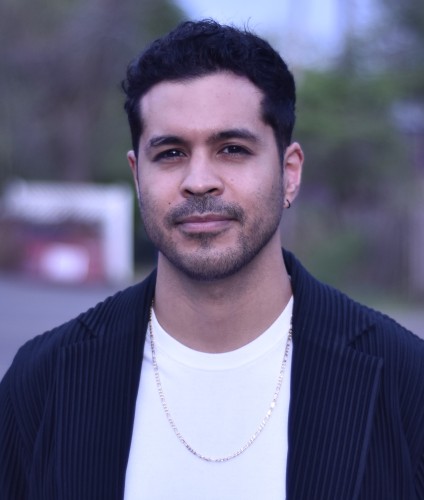
Robert Franco joined Kenyon’s faculty in 2021. He is a historian of modern Mexico whose research and teaching focus on the role of gender & sexuality in political and social movements across Latin America and the Caribbean. Franco’s current book manuscript, “Revolution in the Sheets: Sexuality and Tolerance in the Mexican Left," examines the long history of homophobia, heterosexism and hostility towards sexual rights in Mexico’s leftist parties and organizations. His work has been supported by the Fulbright Foundation, the American Council of Learned Societies, and the Ford Foundation, among others. Pieces of his research can be found in the Journal of the History of Sexuality, Radical History Review, and the Journal of Latin American Cultural Studies. At Kenyon, he teaches courses on Early and Modern Latin America, the history of Mexico, and global histories of gender & sexuality.
Prior to arriving in Gambier, Franco was a postdoctoral fellow in the Department of Women, Gender, and Sexuality Studies at Washington University in St. Louis. Born and raised in Philadelphia, his familial roots stretch from Puerto Rico to Ecuador. He is also a trained glassblower and glass artist.
Franco is on leave until spring 2026.
Areas of Expertise
Latin America and the Caribbean, gender and sexuality, disability studies
Education
2020 — Doctor of Philosophy from Duke University
2017 — Master of Arts from Duke University
2014 — Bachelor of Arts from University of Pennsylvania
Courses Recently Taught
This seminar introduces first-year students to the study of history at Kenyon College by employing certain basic skills and methods to examine a particular theme in world history. Each section of the seminar is taught by a different instructor and has a different focus, but all of the sections emphasize close reading of primary sources, analysis of how scholars have interpreted those sources, comparison of case studies in different regions of the world, study of change over time, intensive writing assignments, and occasional guest lectures by other History faculty. In comparing cases from different times and places that are related to a common theme, the course and its instructor also model the dual skills of specialization and synthesis that students are expected to exercise in completing the field and distribution requirements of the History major.
What is Latin America’s colonial legacy? How do we amend a history of death and destruction with one of cultural exchange and dynamism? How was colonialism instituted through violent and nonviolent methods? And how do the legacies of colonialism continue to impact the region? This course is an introduction to Latin America’s rich colonial history, emphasizing the roots of the region’s diversity. Using daily life as a lens to study the establishment and maintenance of Iberian colonialism, the course examines the mixed results of the encounter between European, African, Asian and Indigenous groups; the power dynamics between colony and metropole; and how the story of “conquest” has elicited debate. We begin by tracing some of the cultural backgrounds of the men and women who would go on to form the foundation of colonial society. As the course progresses, we explore how colonial subjects lived, worked, married, ate, had sex, worshiped and socialized, and how these daily rituals were influenced by the larger structures of colonial power. Lectures and reading assignments draw upon a variety of sources, including court cases, biography, travel accounts and visual sources. The course concludes with an analysis of the Age of Revolutions, a period of dramatic upheaval that forever changed the continent. Previous study of Latin America or fluency in Spanish, French and/or Portuguese is not needed. This counts toward the premodern and Europe/Americas requirements for the major; and for the Americas, global medieval and early modern, and colonial and imperial fields. No prerequisite.
Are revolutions ever as revolutionary as they promise to be? When is incremental change advocated over large-scale reform? And when is revolution seen as the only option? Are the promises of a charismatic leader just a way to manipulate the masses, or are the masses shaping their leaders? And what happens when things go awry? This course asks these questions in the context of contemporary Latin America. It examines the region’s history from independence at the beginning of the 19th century to redemocratization at the end of the 20th. The central and recurring theme of the course is the narrative of reform versus revolution and the (often unintended) consequences of each. Throughout the course, we encounter debates about nationhood, modernization, imperialism and sovereignty, often from the perspectives of historical figures like Ernesto "Çhe" Guevara and Frida Kahlo. In doing so, we can begin contextualizing the circumstances of men and women’s actions, the various possibilities of freedom they envisioned, and the factors leading to their decision to rebel, accommodate or find a third path. Prior study of Latin America, or study of Spanish, French or Portuguese are not needed. This class counts toward the modern and Europe/Americas requirement for the major, and the Americas field. No prerequisite.
In this course we address the formation and evolution of Mexico from approximately 1800 to the near present, noting aspects of its history as a Spanish colony and an independent republic. The course covers issues associated with Mexico's changing, complex identity and how the inhabitants of the region have expressed different sentiments and perceptions about their communities, state and nation. We thus explore questions raised by relations between indigenous peoples and various, predominantly Hispanic, ruling groups, as well as questions about class and gender, and political and economic organization. The class alternates or mixes lectures with discussions. This counts toward the modern and Europe/Americas requirements and the colonial/imperial field for the major. No prerequisite. Offered every other year.
Special Topic
This seminar introduces students to the subject of the Mexican Revolution, which defies easy description. The course examines the major social and political struggles of the revolution, their origins and their implications as the country emerged from civil war in the 1920s and then underwent substantial reform in the 1930s. Further, the seminar considers the meaning(s) of the revolution and how it has been conceived and reimagined in cultural and ideological terms. We examine primary sources in class, but the assignments and reading focus on the historiography concerning the revolution and on the interpretation of its political, social and cultural significance. Students should have some historical knowledge of the late 19th and 20th centuries and be prepared to quickly gain an overview of the main events of modern Mexican history. This counts toward the modern and Europe/Americas requirement and the colonial/imperial field for the major. No prerequisite. Sophomore standing. Offered occasionally.
From Ricky Martin’s “coming out” to the outcry over Jennifer Lopez’s derrière at the Super Bowl, Latin bodies have elicited heated debates over gender, race, citizenship, and sexuality. In this course, we will wade into historiographical debates about the use of queer theory and feminism in the history of gender and sexuality in Latin America, showing how history oftentimes subverts major theoretical interventions. For example, queer theory has staked its intervention in the promise to disrupt binary categories – hetero/homosexuality, male and female, among others. Meanwhile, the impossibility of Latinidad to be confined to either category of race or ethnicity – from Afro-Latinx movements to Chicano indigeneity – disrupts the racial/ethnic binary. Latinidad, in many ways, “queers” ethnicity and race. So how do we reconcile these intellectual projects? By examining the development of Latin American and Latinx history through the lens of gender and sexuality, we will analyze the theoretical, methodological and\nepistemological differences between essentialist and constructivist approaches to the history of sexuality by using the diversity of sexual cultures within Latin America. We will explore how different scholars consider the social construction of gender & sexuality and their relationship to economics, culture, kinship and social structure, and in particular, the ways in which they sexuality are central to political power in Latin America, particularly the relationship between sexual norms and colonial power, social control, nation building, and revolutionary movements. Themes we will explore include feminism, sodomy, bigamy, sexual “inversion”” and homosexuality, sex work, and transgender rights. Offered every other year.
This seminar offers students a chance to examine sexuality from a historical perspective. We study works by historians who have taken sexuality as their category of analysis, and in the process, have engaged with queer, postmodern and feminist theories of sexuality. We do so to highlight how the history of sexuality can be a pathway to revise broad historical narratives, and also how the field does not have a set of strictly defined methods. Instead, we learn of the variety of research methods and theoretical interventions scholars have used to write the history of sexuality from autoethnography to archival research. By focusing on theoretically informed histories (not limited to those written by professional historians) and reflecting on their methods, we highlight how scholars have used sexuality to catalyze new debates on the creation of subjects, citizens and archives. The semester begins with the classic text in the history of sexuality and queer theory: Michel Foucault’s "The History of Sexuality, Volume One," which developed a critical approach for understanding sexuality from a historical perspective. We then spend time examining how historians have taken up and scrutinized Foucault’s call to historicize sex. In doing so, we highlight the limits and gaps in his chronological and theoretical claims through analyses of race, empire and class. Next, students discuss the development of a colonial and postcolonial historical method, as well as works by scholars who have taken up pleasure – through BDSM and the orgasm – as their method of studying sexuality’s history. The course concludes by discussing critical challenges to the history of sexuality from trans, bisexual and BIPOC scholars. Knowledge of queer theory and archival methods is helpful. This counts toward the women, gender and diversity field for the major. No prerequisite. Sophomore standing.