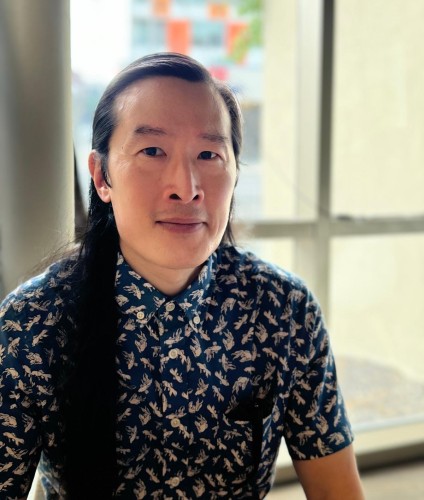
Michael Leong is the author of the critical study "Contested Records: The Turn to Documents in Contemporary North American Poetry" (University of Iowa Press, 2020) and the poetry books "e.s.p." (Silenced Press, 2009), "Cutting Time with a Knife" (Black Square Editions, 2012), "Who Unfolded My Origami Brain?" (Fence Digital, 2017), "Words on Edge" (Black Square Editions, 2018), and "Dear Vase Already Shattered Against the Fragile Floor" (Black Square Editions, 2025). His creative work has been anthologized in "The &NOW Awards 2: The Best Innovative Writing" (Lake Forest College Press, 2013), "Best American Experimental Writing 2018" (Wesleyan University Press, 2018), and "Bettering American Poetry, Volume 3" (Bettering Books, 2019). His co-translation, with Ignacio Infante, of Vicente Huidobro’s long poem "Sky-Quake: Tremor of Heaven" was published by co•im•press in 2020.
Leong is co-editor of Journal of Modern Literature. He is currently working on a long poem called "Disorientations" and a critical book tentatively entitled "Post-Craft: Essays on Pedagogy, Poetics, and Experimental Literature."
Areas of Expertise
Creative writing, American literature, poetry studies
Education
2013 — Doctor of Philosophy from Rutgers, the State University of New Jersey
2003 — Master of Fine Arts from Sarah Lawrence College
2000 — Bachelor of Arts from Dartmouth College
Courses Recently Taught
This course begins with two premises: that students of the craft of poetry should be challenged to write in as many different ways as possible and that students are individual writers with different needs and goals. In this course, we study a variety of types of poetry. Regular writing exercises encourage students to widen their scope and develop their craft. The course emphasizes discovering the "true" subject of each poem, acquiring the skills needed to render that subject, understanding the relationship between form and content and, finally, interrogating the role and function of poetry in a culture. In addition to weekly reading and writing assignments, students submit a process-based portfolio demonstrating an understanding of the revision process and a final chapbook of eight to twelve pages of poetry. This counts toward the emphasis in creative writing and the creative practice requirement for the major. Admission is open, though students may not take this course in the first semester of their first year. Seats are reserved for students in each class year. Offered every year.
This class on contemporary Asian American poetry is a reading-focused class for creative writers. Although some limited workshopping occurs (in both large and small groups), this is not a typical creative writing workshop. A major premise of “Asian American Poetry” is that a rich understanding of both text and context contributes to the creation of more sophisticated creative work that can dynamically think across social, political, cultural, and aesthetic domains. On the one hand, Asian American poetry in the 21st century is enjoying an increasing amount of community building and visibility. There are new publication venues, such as the Asian American Literary Review and Lantern Review, both established in 2010. The important arts organizations Kundiman (founded in 2004) and the Asian American Writers’ Workshop (founded in 1991) continue to extend their programming: the former established an annual book publication prize in 2009 and the latter launched the online magazines, The Margins and Open City, in 2012. The new century has also witnessed the first academic monographs on Asian American poetry and such groundbreaking scholarship has done much to historicize and interpret a rich body of work. Nevertheless, there is still more work to be done. Even if contemporary Asian American poetry has increased in richness, diversity, and magnitude over the past few decades, it continues to be understudied and misunderstood. This course hopes to rectify this fact by examining recent and contemporary Asian American poetry in books and literary journals. Traditionally, Asian American Poetry Studies has focused disproportionately on writers from East Asian backgrounds. A case in point is Dorothy Wang's Thinking Its Presence: Form, Race, and Subjectivity in Contemporary Asian American Poetry (2014), which--while an important intervention--limits its focus to Chinese American poets. This course, in contrast, presents a more expansive discursive field of "Asian Americanness": to that end, recent iterations have included a mini-unit on Hmong American poetry and potential mini-units for future versions may focus on, say, Afghan American poetry or Palestinian/Lebanese American poetry. Course requirements include regular attendance, sustained engagement with assigned readings, a short response essay, original poetry writing and participation in group critique, a final portfolio of creative work accompanied by a writer's statement, and a brief presentation. This counts toward the creative practice and diversity requirements for the major. Students doing the emphasis in creative writing can count this course for their intro workshop requirement. Prerequisite: ENGL 103 or 104.
Prerequisite: ENGL 103 or 104. Only open to first-year and sophomore students.
This course sets out to trouble your assumptions — both conscious and unrecognized — about poetry: writing it, reading it, responding to it; its purpose, its nature, its public and private selves. We explore revision in the fullest senses of the word, aiming not only toward compression and economy but also toward expansion and explosion, toward breaking down the boundaries between what constitutes — for the student as writer and reader — poem and not-poem. We reverse the usual order of things: Our workshopping focuses on canonized poems; students should expect to engage fully in the role of poet-critic when responding to classmates' work, approaching it as they approach texts in the literature classroom. We explore poetry's technologized face through blogs and webzines, even as, Luddite-like, we hand-write, cut, paste, find and memorize poetry. This class requires intensive reading (and attendant thoughtful response) in poetry and poetics; enthusiastic engagement with exercises in critique, revision and poem-making; and a final project, demonstrating advancement as both critic and poet during the course of the semester. Texts likely include several volumes of contemporary poetry, selected critical essays, manifestoes, writings on process and readings by visiting writers. This counts toward the creative writing emphasis and the creative practice requirement for the major. Prerequisite: ENGL 201 or 205 (or an equivalent introductory workshop) and permission of instructor via application. Consult the department for information on the application process and deadlines.
Students in this workshop undertake an extended creative project in poetry (18-25 pages), which may count as their Senior Capstone project. Students have the opportunity to workshop this project over the course of the semester, and study critical and creative readings chosen by the instructor. Prerequisites: ENGL 301 or ENGL 305 and permission of instructor. Senior English majors only.
This seminar is required for English majors pursuing an emphasis in creative writing. The course involves critical work on a topic chosen by the instructor (such as "Reliable and Unreliable: Investigating Narrative Voice," "Beginnings and Endings," "The Little Magazine in America" and "Documentary Poetics") to provide context and structure for students' creative work. Students should check online listings for the specific focus of each section. Although not primarily a workshop, this seminar requires students to work on a substantial creative project (fiction, nonfiction or poetry). Senior English majors pursuing an emphasis in literature are required to take ENGL 410 instead. Students pursuing honors will take ENGL 497 rather than the senior seminar. Senior standing and English major.
Individual study in English is a privilege reserved for senior majors who want to pursue a course of reading or complete a writing project on a topic not regularly offered in the curriculum. Because individual study is one option in a rich and varied English curriculum, it is intended to supplement, not take the place of, coursework, and it cannot normally be used to fulfill requirements for the major. An IS earns the student 0.5 units of credit, although in special cases it may be designed to earn 0.25 units. To qualify to enroll in an individual study, a student must identify a member of the English department willing to direct the project. In consultation with that faculty member, the student must write a one- to two-page proposal that the department chair must approve before the IS can go forward. The chair’s approval is required to ensure that no single faculty member becomes overburdened by directing too many IS courses. In the proposal, the student should provide a preliminary bibliography (and/or set of specific problems, goals and tasks) for the course, outline a specific schedule of reading and/or writing assignments, and describe in some detail the methods of assessment (e.g., a short story to be submitted for evaluation biweekly; a 30-page research paper submitted at course’s end, with rough drafts due at given intervals). Students should also briefly describe any prior coursework that particularly qualifies them for their proposed individual studies. The department expects IS students to meet regularly with their instructors for at least one hour per week, or the equivalent, at the discretion of the instructor. The amount of work submitted for a grade in an IS should approximate at least that required, on average, in 400-level English courses. In the case of group individual studies, a single proposal may be submitted, assuming that all group members follow the same protocols. Because students must enroll for individual studies by the seventh class day of each semester, they should begin discussion of their proposed individual study well in advance, preferably the semester before, so that there is time to devise the proposal and seek departmental approval.