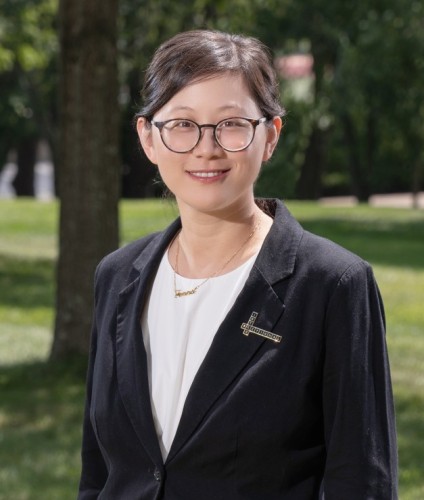
Lin Li is the James P. Storer Assistant Professor of Asian History at Kenyon College, working closely with faculty, staff and students in history, Asian and Middle East studies, and international studies. Originally trained as a historian of gender and sexuality in East Asia, Li's teaching and research interests have expanded to ethnicity, race and disability. Inspired by scholars such as Iris Marion Young and Catherine Lu, Li uses a structural injustice approach in historical research and pedagogy. Li's teaching philosophy centers on helping students recognize the continuity between historical and contemporary injustices as well as develop a sense of historical imagination.

Li received a Ph.D. in East Asian history from the University of Wisconsin-Madison with a minor in gender and women’s studies, after which Li completed a postdoctoral fellowship at Stanford University’s Clayman Institute for Gender Research. Prior to Kenyon College, Li worked as an assistant professor of history at the University of St. Thomas in the Twin Cities. Li is a co-founder of the Transnational Disability Studies working group, and currently serves as the chair of National Women’s Studies Association’s North American Asian Feminist Collective caucus. 

Li's articles have appeared in Journal of Asian Studies, International Feminist Journal of Politics, and Frontiers: A Journal of Women Studies. Li has also been interviewed for several podcasts including East Asia for All and Gleaners. For the latest updates on publications, please visit kenyon.academia.edu/LinLi.

Areas of Expertise

East Asia, gender, disability, race and ethnicity, historical memory, popular culture

Education

2020 — Doctor of Philosophy from Univ of Wisconsin-Madison

Courses Recently Taught

This course is designed to introduce students to the study of Asia and the Middle East within the context of the global humanities. It serves as a sampler, which exposes students to the rich diversity of Asian and Islamicate humanities. The seminar explores a wide range of primary sources from different places and historical periods. These may include such diverse materials as the memoirs of the medieval Muslim traveler Ibn Battuta, "The Analects of Confucius," readings from the "Vedas" and "Upanishads," Farid ud din Attar's "The Conference of the Birds," Kurosawa's "Rashomon," Rabindranath Tagore's "The Home and The World," short fiction from the modern Palestinian author Ghassan Kanafani and examples of contemporary Chinese science fiction. This interdisciplinary course does not count toward the completion of any diversification requirement. Only open to first-year students.

This capstone seminar is taught by Asian Studies Program faculty in rotation and is organized around a common theme that integrates the various disciplines and regions of Asia. Through readings, films, guest lectures and other activities, the course leads students to synthesize their academic and personal (e.g., off-campus) experiences in a broader comparative perspective. Students produce work that examines one or more topics of their own interest within the comparative Asian framework. Required for Asian studies concentrators and joint majors. This interdisciplinary course does not count toward the completion of any diversification requirement. No prerequisite. Permission of instructor required. Senior standing. Offered every spring.

The arrival of Portuguese ships off the coasts of China and Japan in the 16th century, followed by other European merchants, turned East Asia into a major theater of events shaping the emerging modern age. This course examines the sources and dynamics of change -- social, economic, geopolitical and cultural -- in the local and intramural arenas of East Asia as its economies and peoples became entangled in the rise and expansion of Euro-American imperial enterprises. The changes were violent and transformative, leaving deep impressions. Local understandings of past events continue to animate domestic politics and regional relations in the global competition for survival today. Focusing on China, Korea and Japan (acknowledging that the Philippines was the first real European colony in East Asia, and Vietnam the second), the class explores the processes of becoming modern for individuals, state and the region, and the diverse interpretations of those processes. This counts toward the modern and Asia/Africa requirements and the colonial/imperial field for the major. No prerequisite. Offered every or every other year.

This course focuses on China, Korea and Japan before the rise of European maritime dominance (from the 16th century on), and the region's role in the early globalization of world exchange. East Asia emerged as a coherent cultural area in the first millennium C.E., with the introduction and spread of Buddhism, a religion whose faith and associated practices profoundly stamped the physical and human landscape of the region. Significant shifts in the 12th to 18th centuries C.E. highlight the Confucianization of family, gender, politics and kingship during these later centuries. The Mongol and Manchu conquests of the 13th and 17th centuries mark key transition points in this process, as well as in shaping regional and global relationships of exchange. This counts toward the premodern and Asia/Africa requirements for the major. No prerequisite. Offered every other year.

Special Topic

Special Topic

Special Topic

Special Topic

This course focuses on the conceptual frameworks used by historians and on debates within the profession about the nature of the past and the best way to write about it. The seminar prepares students of history to be productive researchers, insightful readers and effective writers. The seminar is required for history majors and should be completed before the senior year. Open only to sophomores and juniors. This counts toward the practice and theory requirement for the major. Declared history or international studies major only.