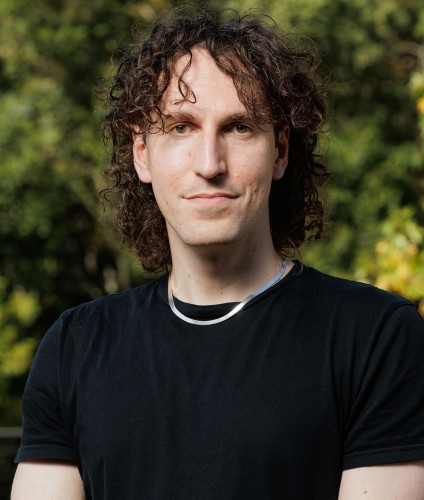
John Rufo is assistant professor in American studies and associated faculty in gender and sexuality studies. Rufo’s research focuses on the aesthetics of social movements in the Americas, with special consideration given to the relationship between abolition, Black feminism and internationalism. Ongoing research has been published in Diacritics and is forthcoming in Social Text and the Journal of Transnational American Studies. Rufo's first book project is under advance contract with Cambridge University Press, through the series Cambridge Core Elements in Feminism and Contemporary Critical Theory.
Rufo’s classes center struggles in American culture, politics and social life related to race, gender, sexuality, class, nation and disability. They regularly offer interdisciplinary courses on the carceral, the anti-colonial, and the life and work of figures like Angela Davis. Prior to Kenyon, Rufo taught at Dickinson College in American studies, Hunter College in English, and the City College of New York in Black studies. Broadly trained in the arts and humanities, Rufo earned their Ph.D. in English and American studies from the Graduate Center, CUNY; an M.F.A. in “Image Text” (visual culture and creative writing) from Ithaca College; and a B.A. in interdisciplinary studies with honors from Hamilton College. Additionally, they have participated in the Futures of American Studies Institute at Dartmouth College.
They also practice poetry and poetry criticism, publishing with the Academy of American Poets, Ploughshares, the Capilano Review and elsewhere. Co-founding the Poetry Project Editorial Collective, they worked with the Poetry Project Newsletter from 2017-2021.
Areas of Expertise
Abolition; Black feminism; critiques of racial capitalism; prison and policing; cultural theory; autobiography; rhetorical tropes (metaphor/metonymy)
Education
2023 — Doctor of Philosophy from the Graduate Center, CUNY
2019 — Master of Fine Arts from Ithaca College
2016 — Bachelor of Arts from Hamilton College NY
Courses Recently Taught
American culture is saturated with representations of prisons and policing. How are those representations produced, circulated and challenged? This course examines various community and local organizational efforts to confront the real material effects of prisons and policing, which make up the largest predominantly state-run programs in the United States. Focusing on the late 20th century and contemporary period, we work through understanding the historical emergence of prisons and police by way of class, race, gender, sexuality, and disability, with primary consideration given to analysis that centers on reform or abolition of prison and police. The carceral texture and disciplinary features of this country’s uneven geography give us the opportunity examine to troubled borders, local jails, pre-trial detention, supermax facilities, sentencing, solitary confinement and many more forms of state-coordinated caging. This course serves as an introduction to the interdisciplinary field of American studies, with special attention to literature, history, sociology, geography politics, economics, and cultural theory. Texts include work by Stuart Hall, Ruth Wilson Gilmore, Angela Davis, Brett Story, Alex Vitale, and Mariame Kaba, among others. Typical reading of between 40-60 pages per week, with close reading required. This counts as an introductory course for the major or toward the politics, culture and society requirement for the major. No prerequisite.
This course provides a thematic survey to the history of American Studies as a field by focusing on three major subjects in the interdiscipline: Flesh, Nation, and Abolition. “Flesh” vitally expresses women-of-color feminism’s influence on American studies through intimacy, contact, and organized responses to violence; “nation” troubles the historically contested boundaries of border, region, territory, and imagined communities; and “abolition” overturns the status quo expectations of ongoing forms of domination via de facto and de jure modes of racism, gender- and sexuality-based discrimination, and other forms of structural antagonism. We ask: how has American Studies changed over time? As an interdisciplinary field which emerged in the early 20th-century United States, American studies has undergone a series of remarkable self-reflexive transformations since its founding, or, in the words of Gene Wise, “paradigm dramas.” American studies has taken on internationalist dimensions to the study of the Americas, plural, with an eye on critiquing the cultural, political, and economic dominance of the United States, with interventions from the American Studies Association and its journal, American Quarterly, serving as flashpoints. We survey both canonical texts in the discipline, alternate counter-genealogies, and recent scholarship from the past several years. This counts toward the politics, culture, and society requirement for the major. No prerequisite.
Between the House Un-American Activities Committee, the anti-communism of McCarthyism more specifically, and all manner of local and federal political repression, from the MOVE bombing in Philadelphia to CIA-backed coup d’etat in multiple countries in the global South, the United States government has been distinctly involved in anti-communist work and anti-Black radical activism in the 20th century and beyond. In this course, we investigate the long history of “Un-American Studies,” reaching from as far back as the foundations of settler-colonialism in the Americas to the various recent anti-immigrant efforts to “secure the border” and Islamophobic/xenophobic “Muslim bans” in our more contemporary period. At stake is the history of radical social movements fighting for various forms of liberation around the world and “at home,” and the opposition they face from being deemed “un-American” and “communist.” We think through particular cases at multiple scales: the non-aligned movement, the Cuban revolution, the contentious relationship between the United States and the Soviet Union, and specific activists in the United States who sought out international politics, such as Paul Robeson, Malcolm X, W. E. B. Du Bois, Angela Davis, and Assata Shakur. Finally, we consider how past and present day incarceration-- in which more people in the United States are stripped of basic legal and human rights on a daily basis than in nearly every other country in the world-- informs our current understanding of “un-Americanism” and present day Black radicalism and the ongoing Red Scare. We potentially consult texts by Marx, Cedric Robinson, Stuart Hall, Robin Kelley, Ruth Wilson Gilmore, Gerald Horne, Charisse Burden-Stelly, Vijay Prashad, Alberto Toscano, Vincent Bevins, Donald Pease, Amy Kaplan, Orisanmi Burton, and other scholars of international radicalism, specifically focusing on the rise of Cold War politics and neoliberalism. We potentially watch films such as "Finally Got the News" and "Harlan County, U.S.A." to explore how locally-based labor movements understood themselves in a political war with their very local and state governments. We also consider the various forms of European and American fascism as they emerge as counterrevolutionary countermovements to social movements focused on social life. Ultimately we ask, “What and who is (misnamed as) un-American?” Prerequisite: at least one class in American studies, history, political science, anthropology, sociology, gender & sexuality studies, international studies, or English. \n
Angela Y. Davis is one of the most significant figures in the history of the United States. From her childhood in Birmingham, Alabama in the 1940s, through her status as a political organizer and political prisoner in the late 1960s/early 1970s, to her continued activism in today’s world, studying Davis’s life and work solicits a robust sense of the political, cultural, and economic scene from the vantage point of collective radical struggle rooted in Black radicalism and communism. Davis is an interdisciplinary scholar, Black feminist, Marxist, and prison abolitionist. We read Davis’s work with close attention to these categories as they invoke international politics, history, philosophy, and literature. We alternate between reading her work and\nwriting that contextualizes slavery, communism, prisons, reconstruction, abolition, imperialism, internationalism, Black feminism, the American Indian Movement, the Chicano/a movement, queerness, indigenous life, and Palestine. Finally, we pay special attention to more recent work and writing by Davis, as her devotion to freedom, struggle against class oppression, racism, imperialism, sexism, incarceration, and transphobia continues today. As an upper-level seminar, this course provides a pathway to the capstone in American studies and as a potential introduction to graduate study. Requires junior or senior standing.
The course will provide a setting for advanced guided student work in American studies. Students will work collaboratively to assist one another in the development of individual research projects that represent the synthesis of the six courses they have crafted for the major in American studies. The course is required of all American studies senior majors and concentrators. Permission of instructor required. No prerequisite. Offered every other year in rotation with Senior Colloquium.
This class examines feminist critiques of dominant methodologies and theories of knowledge creation. It focuses on the following questions: How do we know something? Who gets to decide what counts as knowledge? How do gender, sexuality, race, class and other identity categories matter in research? In exploring these questions, we will discuss how power is exercised in the production of knowledge, how the norms of objectivity and universalism perpetuate dominance and exclusion, why marginalized people are often seen as lacking epistemic authority, and what it means to have knowledge produced from a feminist standpoint. We explore a variety of alternative epistemologies and methodologies proposed by feminist and LGBTQ theorists and researchers. Participants in this class will learn several qualitative methods and practice using these methods in their own research. In addition, we will discuss ethical issues within a variety of research contexts and what responsibilities feminist researchers have to the broader community. This course counts towards the methodology requirement for the GSS major and is one of the foundational courses for the GSS concentration. This course paired with any other .50 unit/4 semester hour GSS course counts toward the social science diversification requirement. Prerequisite: any GSS course, approved departmental course.