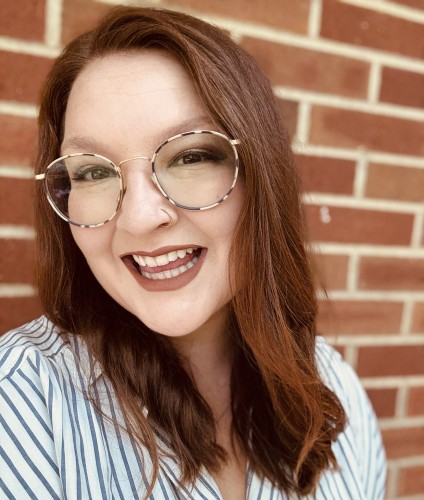
Hannah V Warren is a poet, translator, and scholar from Mississippi. Along with authoring the poetry collections Hurricane Pastoral (Sundress 2027) and Slaughterhouse for Old Wives’ Tales (Sundress 2024), she has received support from Fulbright-Germany, the PEN/Heim Translation Grant, Bread Loaf, and the Foundation for Contemporary Arts. Warren’s writing and research often explore the intersections of gender and perceived monstrosity.
Areas of Expertise
Aesthetics, monster theory, gothic literatures, creative writing craft
Education
2024 — Doctor of Philosophy from University of Georgia
2019 — Master of Fine Arts from University of Kansas
2016 — Bachelor of Arts from Mississippi State University
Courses Recently Taught
This open-enrollment course gives students the opportunity to develop as creative writers and readers through a series of writing assignments and workshops. In addition to poetry and short fiction, areas of focus may include creative essay, playwriting, screenwriting and multimedia works. Students conclude the course by revising and polishing a selection of their original work as a final portfolio. This counts toward the emphasis in creative writing and the creative practice requirement for the major. Seats are reserved for each class year. Students may not take this course in the first semester of their first year.
In recent years, there has been a renaissance of science writing for the common reader that combines literary and scientific merit, from Stephen Hawking's "A Brief History of Time" to Oliver Sacks' "The Man Who Mistook His Wife for A Hat," and from Dava Sobel's "Longitude" to Rebecca Skloot's "The Immortal Life of Henrietta Lacks." Such book explore scientific questions in a style that transcends the conventions of academic science writing or popular history, bringing important questions from physics, biology, chemistry, neuroscience, and mathematics to wider public attention. Short-form science journalism has become one of the most important areas of literary nonfiction, recognized both by annual awards from the American Association for the Advancement of Science and two different series of Best of American Science Writing anthologies. This interdisciplinary science writing course combines literary analysis of exemplary essays on scientific topics with a writing workshop that requires students to closely observe scientific processes, conduct independent research and interviews, interpret data, and present scientific information in highly readable form. Weekly readings are selected from prize-winning science essays and the Best of American Science and Nature Writing series. We may also read one book-length work of science writing. Weekly writing assignments include journals, observational accounts of science experiments, exercises in interpreting scientific data, interviews, narratives and a substantial research essay. This counts toward the creative practice and post-1900 requirement for the major. No prerequisite.
This workshop focuses on discussion of participants' fiction as well as on exercises and playful experimentation. Principally, we are concerned with how stories work at every level. As we consider narrative strategies and practical methods for developing individual styles, along with approaches to revising work, we also read, as writers, a variety of outside texts. This counts toward the creative writing emphasis and toward the creative practice requirement for the major. Prerequisite: ENGL 200, 202 or 204 (or an equivalent introductory workshop) and permission of instructor via application. Consult the department for information on the application process and deadlines.
This workshop focuses on the study and production of creative writing from a multi-genre perspective. Course readings include both poetry and prose; students are free to experiment across multiple and/or hybrid genres. Instructors may choose to focus the course on a particular theme, such as "Subversive Genres," "Ekphrasis," or "Digital Literature." This counts toward the creative writing emphasis and the creative practice requirement for the major. Prerequisites: ENGL 200, 201, 202, 204, or 205 and permission of the instructor via application. Consult the department for information on the application process and deadlines.