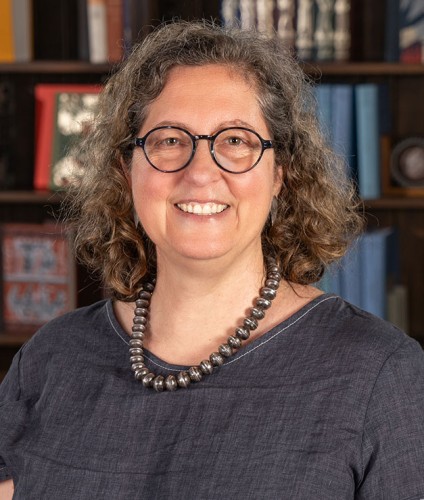
Eliza Ablovatski joined the Kenyon history department in 2003, after graduate work in East Central European history at Columbia University and research and fellowships in Munich and Berlin, Germany and Budapest, Hungary. She teaches classes on Europe from 1500 to the present, focusing on the nineteenth and twentieth centuries, Germany, Russia, the Habsburg Monarchy, film, nationalism and identity, gender, race and the interwar period.
Her dissertation and first book, "Revolution and Political Violence in Central Europe: The Deluge of 1919" focus on the revolutionary upheavals in Munich and Budapest following the First World War and their relationship to political violence and antisemitism. She is currently researching the occupation of Austria (1945-1955) at the end of the Second World War and the nuclear idea in postwar Europe. She has also researched and written extensively on the history of Jews in the former Habsburg regional capital of Czernowitz (now Ukraine).
Areas of Expertise
Modern Europe, especially Germany and Central/East Central Europe in the nineteenth and twentieth centuries, European Jewish and women’s history, East European and German film and literature, socialism, war and revolution
Education
2005 — Doctor of Philosophy from Columbia University
1998 — Master of Philosophy from Columbia University
1996 — Master of Arts from Columbia University
1993 — Bachelor of Arts from Amherst College
Courses Recently Taught
The European continent is incredibly diverse: geographically, culturally, economically, ethnically and politically (to name only the most obvious factors). Throughout the semester we explore this diversity of experiences since the end of the 18th century. We look at issues of race, class and gender, as well as violence, poverty, faith, nationalism, technology and art. We read novels and memoirs, watch films and listen to music as we hone our historical knowledge and sensibilities regarding modern Europe, its peoples and its governments. We examine the fates of a variety of nations, using examples from across the continent. This counts toward the modern and Europe/Americas requirements for the major. No prerequisite
As a political entity, the aggregation of central European lands ruled from Vienna for almost four centuries constitutes the strangest major power on the European scene in the past 500 years. Alone among the great states of Europe, the Habsburg realm accepted cultural heterogeneity and actively sought to avoid war. This course assesses the Habsburg experiment in political and cultural multiculturalism, seeking finally to account for the empire's inability to survive the tensions of the 20th century. Among the subjects to be considered are Vienna as the cultural capital of Europe, the role of language in politics, the creative rivalry between Prague and Vienna, the emergence and character of nationalism, the postwar successor states, and the concept of Central Europe. The course involves lectures and discussions. This counts toward the premodern and Europe/Americas requirements and the colonial/imperial field for the major. No knowledge of German is required. No prerequisite.
This survey of the history of the Russian Empire and the Soviet Union in the modern era introduces students to the region, familiarizes them with the major periods of modern Russian history and helps them to understand some of the important historical issues and debates. Students should develop an appreciation for the ethnic, social and cultural diversity of both the Russian Empire and the Soviet Union as well as for the ways in which political events shaped the personal lives of the country's population. Though focusing on 20th-century history, this course begins with an introduction to the social structures, ethnic composition and political problems of the late Russian Empire. We cover the Russian Revolution and early Soviet history, then turn our attention to Stalinism, collectivization, terror and the Second World War. In the postwar era, we examine the failure of the Khrushchev reforms and the period of stagnation under Brezhnev, before turning to Gorbachev and the reforms of perestroika. At the end of the semester, we approach the end of the Soviet Union and its legacy for the many successor states (not only Russia). Although organized along the lines of political periodization, the class emphasizes the perspectives of social and ethnic diversity as well as culture and gender. We look at art, literature and music, and we attend film screenings outside class. Historical background in modern European history is recommended. Russian and other regional language skills are welcomed. This counts toward the modern and Europe/Americas requirement and the colonial/imperial field for the major. No prerequisite.
Modern German history is often seen as a tension between the land of the "poets and thinkers" (Dichter und Denker) and the "land of the murderers and executioners" (Mörder und Henker). In this class, we use the perspectives of gender, race and class to explore and illuminate the main themes and topics in modern German history, beginning with the Enlightenment and the French Revolution, up to reunification and European Union membership in the present. German language is not required. One unit of history, English or modern languages is recommended. This counts toward the modern and Europe/Americas requirements and the women, gender and sexuality field for the major. No prerequisite. Offered every two or three years.
One hundred years ago, the European powers went to war over dynastic honor after the heir to the Habsburg throne was assassinated in Sarajevo. Four years later, all the European empires had fallen to revolution and defeat and Europe was transformed. The war inspired not only socialist revolutions but also revolutions in technology, art and daily life. We look at the experience of soldiers fighting and new technologies of warfare; civilian suffering, hunger and political radicalization; modernist art and music; postwar experiments in urban architecture; women's emancipation; and political violence and ethnic cleansing. This upper-level seminar examines the war, its causes, course and consequences, with a special emphasis on historiography, the way the war was interpreted at the time and over the century since. Students work with a variety of primary sources and conduct their own research project over the course of the semester. The course is intended for advanced history students, but students from other disciplines with an interest in the time period are welcome. Students without a modern Europe or equivalent history course should contact the professor about their preparedness. This counts toward the modern and Europe/Americas requirements for the major. No prerequisite. Sophomore standing. Offered every three years.
This seminar examines the explosion of creativity and radicalism in late Habsburg society, focusing on the capital city, Vienna. In the years before and after 1900, Vienna was a vibrant city, home to many of the most important creators of early 20th-century modern culture, among them not only Freud but also such figures as Gustav Klimt, Egon Schiele, Otto Wagner, Karl Kraus, Arthur Schnitzler, Hugo von Hofmannsthal, Robert Musil, Theodor Herzl, Otto Bauer, Karl Lueger, Gustav Mahler and Arnold Schoenberg, to name only a few. Taking the multilingual, multireligious, multiethnic Habsburg monarchy as our base, we follow developments in the fields of psychology, medicine, literature, architecture, art and music, putting them into the context of important political and social movements like socialism, nationalism, anti-Semitism and liberalism. This seminar is designed for junior and senior history majors with a background in European history. However, non-majors with knowledge of or interest in music, art history or German literature are strongly encouraged to join. This counts toward the modern and Europe/Americas requirements for the major. No prerequisite. Sophomore standing.
This seminar examines the mass migrations of people within, to and from modern Europe, with special attention to the plight of refugees from war and violence and the creation of the international legal categories of refugee and asylum. Historical examples begin with the mass emigration of Europeans in the late 19th century and then focus on the two world wars, the Cold War, decolonization and contemporary debates in the European Union over migration, immigration and refugees. Through shared class readings and student research projects, the course investigates the intertwined histories of modern nation-states, border control, citizenship, community, sovereignty and international law, comparing historical and contemporary developments and ideas about human mobility. Throughout the course, we also examine migration as part of the life experiences and identities of people in and from Europe through their own words and life narratives. This counts toward the modern and Europe/Americas requirements and the Europe and colonial/imperial fields in the major. No prerequisite, though familiarity with European history is helpful. sophomore standing.
This seminar introduces students to the German National Socialist regime, to major historical debates in the field, and to methods of historical research and writing. We begin with the rise of the NS party and the problems of the Weimar Republic in the late 1920s and end with the defeat of Germany and its military occupation after May 1945, looking at major questions including anti-Semitism; Nazi party support; collaboration; terror; and the roles of gender, class and sexuality. The course uses the perspective of daily life to look at the history of Nazi Germany and the Holocaust through sources from below, and the work of historians who use these sources. Students become familiar with the major events of the period and explore many historical debates in depth in the seminar. They also explore a topic of their own choosing through progressive assignments, developing their skills in research and analysis. Prior coursework in European history is strongly recommended. This counts toward the modern and Europe/Americas requirements for the major. No prerequisite. Sophomore standing.
This course looks at the history of the Soviet Union and the post-1945 German and East European socialist states with a concentration on films made in these countries, as well as films made elsewhere or later about life under state socialism. We focus on a few key eras and topics, such as World War II films, Stalinism/socialist realism, the Thaw, the position of women in socialist society and generational conflict. Students are required to attend a weekly film screening and participate in class discussion. During the semester, each student may pick a topic for an in-depth research project. Previous coursework in European history recommended. This counts toward the modern and Europe/Americas requirements for the major. No prerequisite. Sophomore standing.
That “the personal is political” became a rallying cry of feminists in Cold War Western Europe in the late 1960s and 70s, but this claim had already been central to the building of new socialist societies from the early USSR to the postwar socialist regimes in Eastern Europe. In this seminar we look at the way that people on both sides of the Iron Curtain navigated the politics of sex and family in the decades after the Second World War; and how they thought about, defended and lived their private lives in the highly politicized context of the Cold War. We begin with the legacies of the totalizing claims fascism and communism made in WWII; the demographic and personal effects of mass death, displacement, and genocide during the war; the push to rebuild Europe and European economies in the early Cold War context; and the effects of politics, urbanization, migration and evolving claims of political and economic rights in both West and East. We examine in particular changing laws and discourses around youth and youth culture, abortion and birth control, homosexuality, marriage and women’s work. The seminar examines texts, art and films from a variety of European countries, with a focus on gender, race and class. Students have the opportunity to select topics for individual and group research. This course counts toward the seminar, modern, and Europe/America requirements for the major, and toward the Europe and women and gender fields within the major. No prerequisite, though some coursework in either European history or gender and sexuality studies is recommended. Sophomore standing.
The goal of this course is to give each history major the experience of a sustained, independent research project, including formulating a historical question, considering methods, devising a research strategy, locating and critically evaluating primary and secondary sources, placing evidence in context, shaping an interpretation and presenting documented results. Research topics are selected by students in consultation with the instructor. Classes involve student presentations on various stages of their work and mutual critiques, as well as discussions of issues of common interest, such as methods and bibliography. Open only to senior history majors. This counts toward the senior research seminar requirement for the major. Prerequisite: HIST 387. Offered every fall.
Students in this interdisciplinary course will explore the diverse experiences and representations of the Holocaust by curating an exhibit at Chalmers Library and by hearing from a variety of guest speakers from Kenyon and beyond. Even as we draw on traditional historical, archival and testimonial sources in understanding the Shoah and its aftermaths, we will hear from Kenyon community members with personal connections to it, including a public health expert whose mother was a hidden child in a convent in France and an artist whose father was among the American troops who liberated the Buchenwald concentration camp. Other visitors will speak from a more academic perspective about the Nazi notion of “degenerate music”; the global diaspora of Jewish refugees fleeing the Holocaust (including the scholar’s own parents' flight to Tehran); the “entwined” history of Roma and Jewish victims; and the use of sound in (Holocaust) museums. \n\nA large portion of the course will be given over creating an exhibit using artifacts from Kenyon’s Bulmash Family Holocaust Collection. Students will gain hands-on curatorial experience by choosing objects that express their own interests in this difficult subject and deciding how to best contextualize these objects in a way that is thorough and ethical. This course is open to all students and counts for major credit in German, History or Religious Studies. No prerequisite.
This course is designed for sophomores who plan to major in international studies. It explores the evolution of modern international society by examining the roles of industrialization, capitalism, nationalism, individualism and other elements of modernity in propelling and directing the flow of wealth, people and ideas between different regions of the world. In addition to studying general political and economic changes, the course considers various local and personal perspectives, giving life to otherwise abstract forces and complicating attempts to construct a single overarching narrative of "modernization," "Westernization" or "development." Among the issues to be examined are the causes and effects of international economic disparities, migration, cultural tensions and stresses on the environment. In surveying major viewpoints and illustrative cases within these themes, the course is meant to serve as an introduction to the international studies major, utilizing a variety of academic disciplines and providing a foundation for further study of relations between different nations and peoples of the world. As part of the course, students complete a research paper related to the geographic area where they plan to go for their off-campus experience. This interdisciplinary course does not count toward the completion of any diversification requirement. No prerequisite. Second semester, first-year standing. Offered every year.